


Based on a survey conducted by the American Medical Group Association (AMGA), it was discovered that the average provider pay had increased from 2.92% in 2018 to 3.79% in 2019. The survey also found that average work relative value unit production, a measure of provider productivity, increased by 0.56% in 2019, compared to a 0.29% increase in 2018. Compensation per work relative value unit production ratio increased by 2.14% last year compared to 3.64% in 2018. The only unexplained fact is that while pay has increased, the productivity has remained relatively low.
The AMGA’s 33rd annual 2020 Medical Group Compensation and Productivity Survey shows provider pay increased in 2019, but work relative value unit (wRVU) production remained stagnant. This trend mirrors that found in last year’s survey, which showed similar disparities between annual pay and productivity gains.
Fred Horton, M.H.A., AMGA Consulting president, had this to say about the results of the survey, “We have now seen this same trend of divergent key metrics for several years in a row, and we have to wonder how long it can continue, given that the vast majority of revenue is still, by and large, generated via work RVU productivity.” He further added, “AMGA’s members are concerned about this ongoing trend, and we suspect the industry-wide response to COVID-19 will speed up efforts to mitigate this pattern. At the same time, we are seeing revised care models and rapid telehealth expansion. When combined, it is certain that change is taking place, but the ultimate landing place is far from clear.”
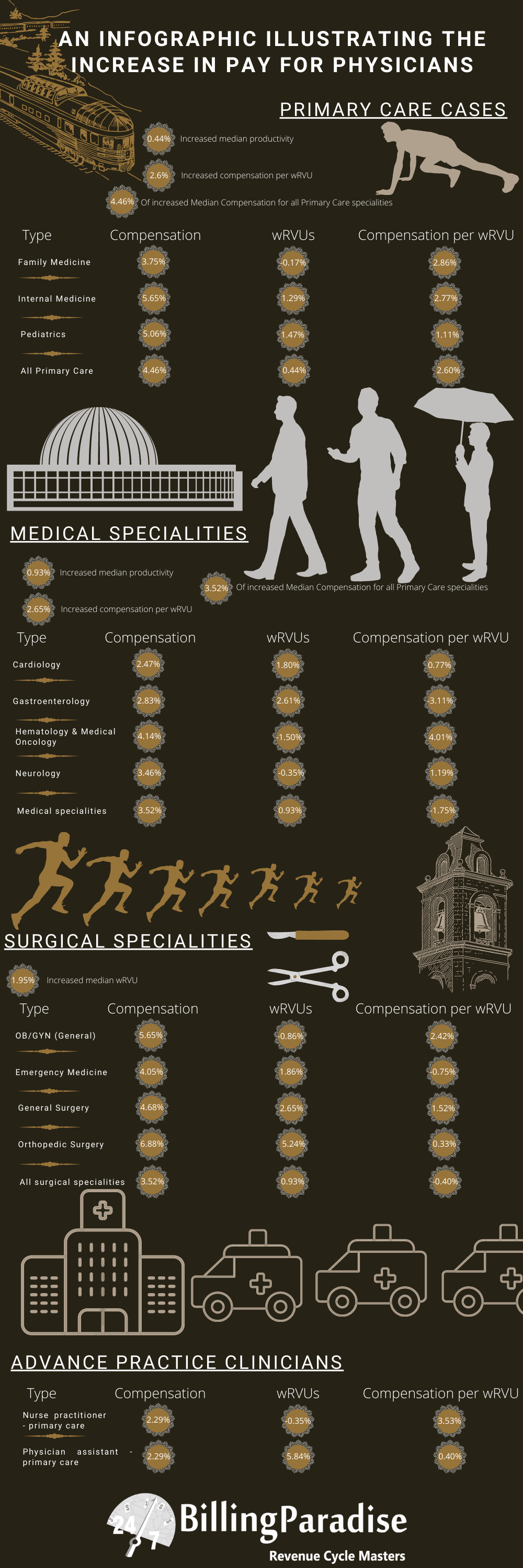
The survey was conducted by AMGA was based on data collected from 317 medical groups, representing more than 127,000 providers from 169 physicians, advanced practice clinician and other specialties. The following infographic illustrates the results of that survey.
Conclusion
- Average provider pay in medical groups climbed 3.79% overall in 2019
- Additionally, average work relative value unit production, a measure of provider productivity, increased by 0.56% in 2019
- Compensation per work relative value unit production ratio increased by 2.14%
- Physicians belonging to the following specialities have experienced pay raises:
- Family medicine: 3.75% increase
- Internal medicine: 5.65% increase
- Pediatrics: 5.06% increase
- Cardiology (general): 2.47% increase
- Gastroenterology: 2.83% increase
- Hematology and medical oncology: 4.14% increase
- Neurology: 3.46% increase
- OB-GYN (general): 5.65% increase
- Emergency medicine: 4.05% increase
- General surgery: 4.68% increase
- Orthopedic surgery: 6.88% increase
While the current pandemic situation might have changed the income for everyone, it is still important to know the progress that healthcare organizations had made prior to the pandemic, so that it can be exceeded post-pandemic.
Fred Horton also said this when asked about the impact COVID-19 would have on this data, “Certainly, a need for a call to action has been heightened, as this market trend persists. Add in the many ramifications and unknowns of COVID-19, and medical groups are operating in unfamiliar and uncomfortable territory.” Horton further added, “The pressure for more operational efficiency is greater than ever, and the concern is that payers, facing some of the same pressures, will push for more managed expense models, rather than profit/risk sharing through two-sided risk. The epic challenges of today will force new thinking and, hopefully, breakthroughs needed for not simply sustaining compensation levels, but leading to organizations that are truly resilient.
Due to the COVID-19 pandemic, it has become increasingly difficult for patients and providers to connect. It has also become nearly impossible for physicians to treat their patients safely. That is why BillingParadise has come up with the most elegant turnkey telemedicine solution. We also provide complete end-to-end IT and billing support. Also, considering the financial constraints of the pandemic, we are waiving all service costs.


