Introduction
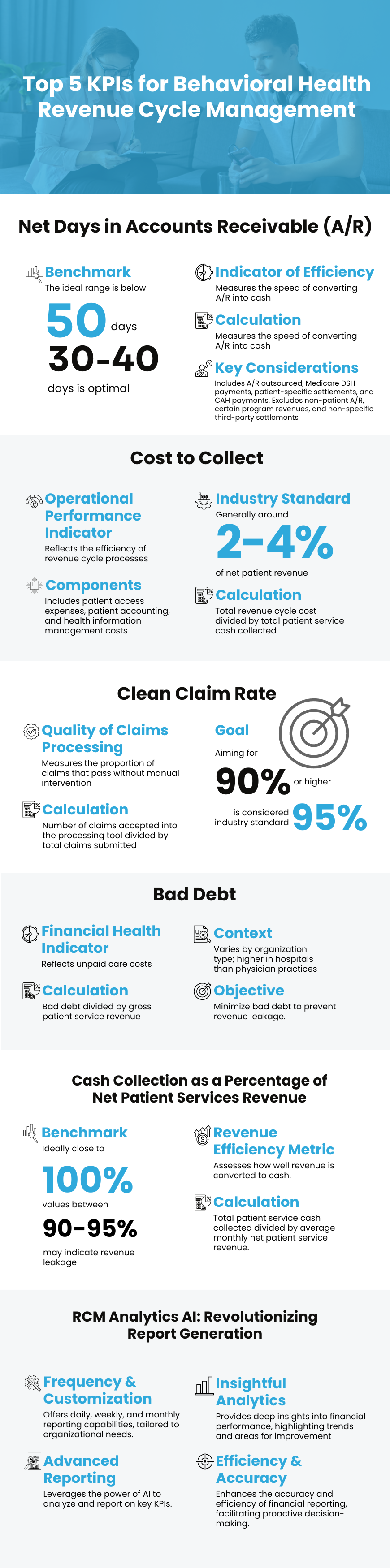
In today’s dynamic Behavioral Health landscape, maintaining financial health is more crucial than ever for healthcare organizations. Balancing quality care with cost efficiency requires a keen understanding of key financial metrics. This infographic presents the top five Behavioral Health Key Performance Indicators (KPIs) that are essential for effective healthcare revenue cycle management. These Behavioral Health KPIs provide valuable insights into operational efficiency, financial stability, and revenue optimization, ensuring healthcare organizations can thrive in a value-based care environment.

Conclusion
Mastering these Top five Behavioral Health Key Performance Indicators (KPIs), along with the advanced insights provided by RCM Analytics AI, offers a comprehensive view of an organization’s financial performance in the healthcare revenue cycle. The integration of AI-driven analytics enhances continuous tracking and improvement in these areas, ensuring not just sustainable financial health but also heightened operational efficiency. This technological advancement allows for smarter, data-driven decisions, propelling Behavioral Health organizations toward a more robust and efficient financial future.
Frequently Asked Questions
Behavioral Health KPIs are specific metrics that measure the financial and operational performance of healthcare organizations focused on behavioral health. These metrics help in evaluating revenue cycle management (RCM) efficiency, financial stability, and overall operational effectiveness.
These KPIs provide actionable insights into key aspects of financial health, such as billing accuracy, claim denial rates, and revenue optimization. By monitoring and improving these metrics, organizations can maintain a balance between quality care delivery and cost efficiency.
The blog outlines five critical KPIs essential for behavioral health organizations. While specific KPIs are not explicitly listed in the excerpt provided, common examples include:
- Days in Accounts Receivable (AR)
- Claim Denial Rates
- Patient Collection Rates
- Net Revenue Collection
- Authorization Adherence Rate
RCM Analytics AI provides real-time insights, automates data tracking, and identifies trends or anomalies in financial performance. This enables healthcare organizations to make data-driven decisions, improve operational efficiency, and optimize revenue.