Table of contents
Is the lack of native batch eligibility verification in eClinicalWorks slowing down your front office?
If you’re using eClinicalWorks, chances are, your staff is checking each patient’s eligibility one appointment at a time. In the early stages, with fewer providers and more limited scheduling, this works just fine. As your practice grows and you add more physicians, locations, and payers, however, those checks become much more challenging.
Front-office staff members spend hours each day reviewing insurance eligibility for routine procedures as more complex cases involving expired referrals and prior authorizations demand their attention in the days leading up to a patient visit.
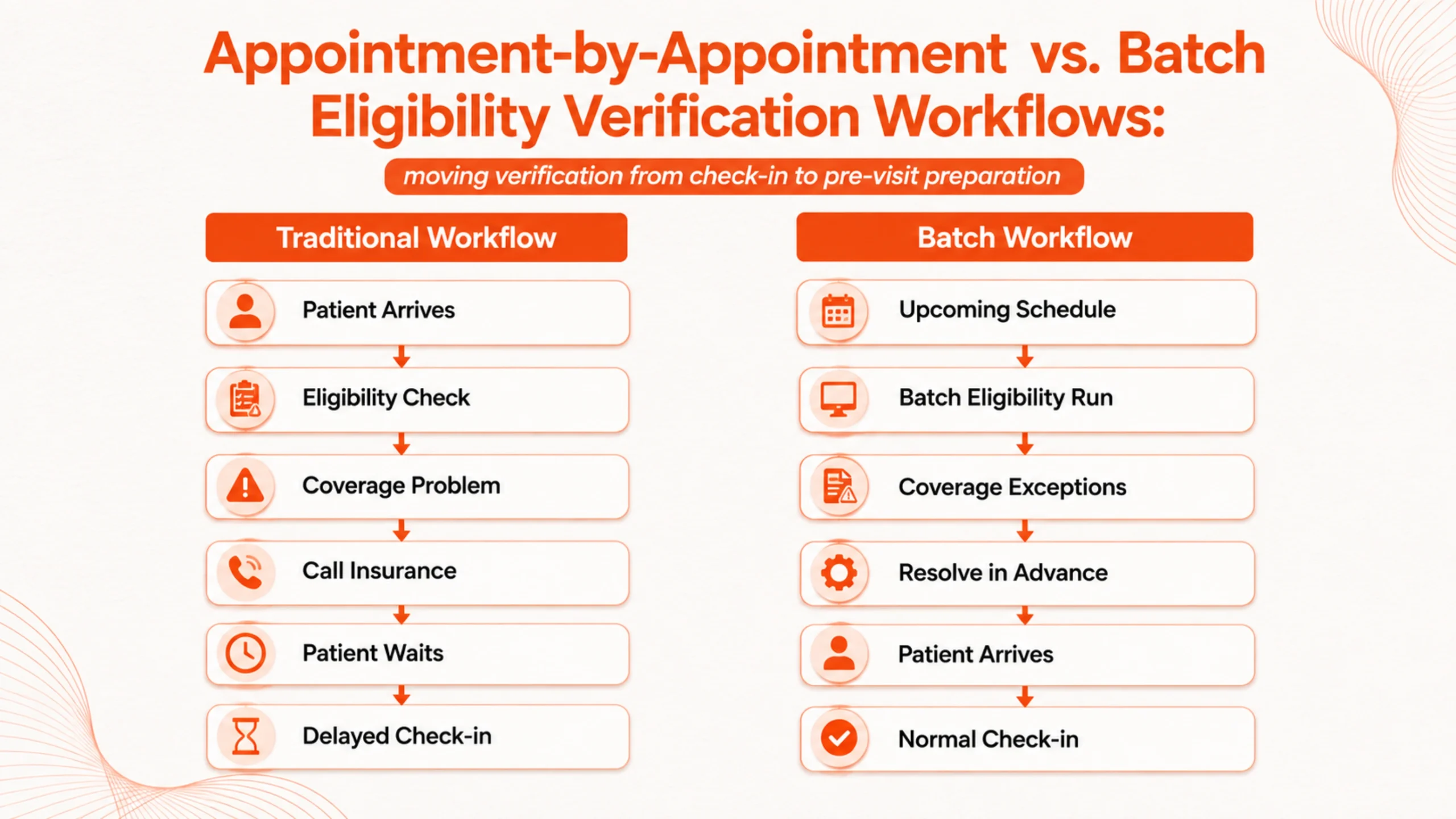
The issue is that an appointment-based approach doesn’t scale well as your practice grows. That’s why many organizations are moving towards a batch, pre-visit approach in which staff review a block of upcoming appointments 24 to 72 hours out on a daily basis, only performing eligibility verification for the exceptions.
The Growing Complexity of Eligibility Verification for eClinicalWorks Users
In order to research the underlying reasons why eligibility verification is a challenge for the users of eClinicalWorks, we have thoroughly examined the eClinicalWorks user communities, practice administrator forums, customer reviews, and revenue cycle communities.
Our analysis revealed that as the number of patient appointments increases, practices have a difficult time moving beyond manual, appointment-by-appointment verification of insurance eligibility, which creates less time for staff to resolve the exceptions prior to the date of service.
How Appointment-by-Appointment Verification Creates Front-End Revenue Leakage
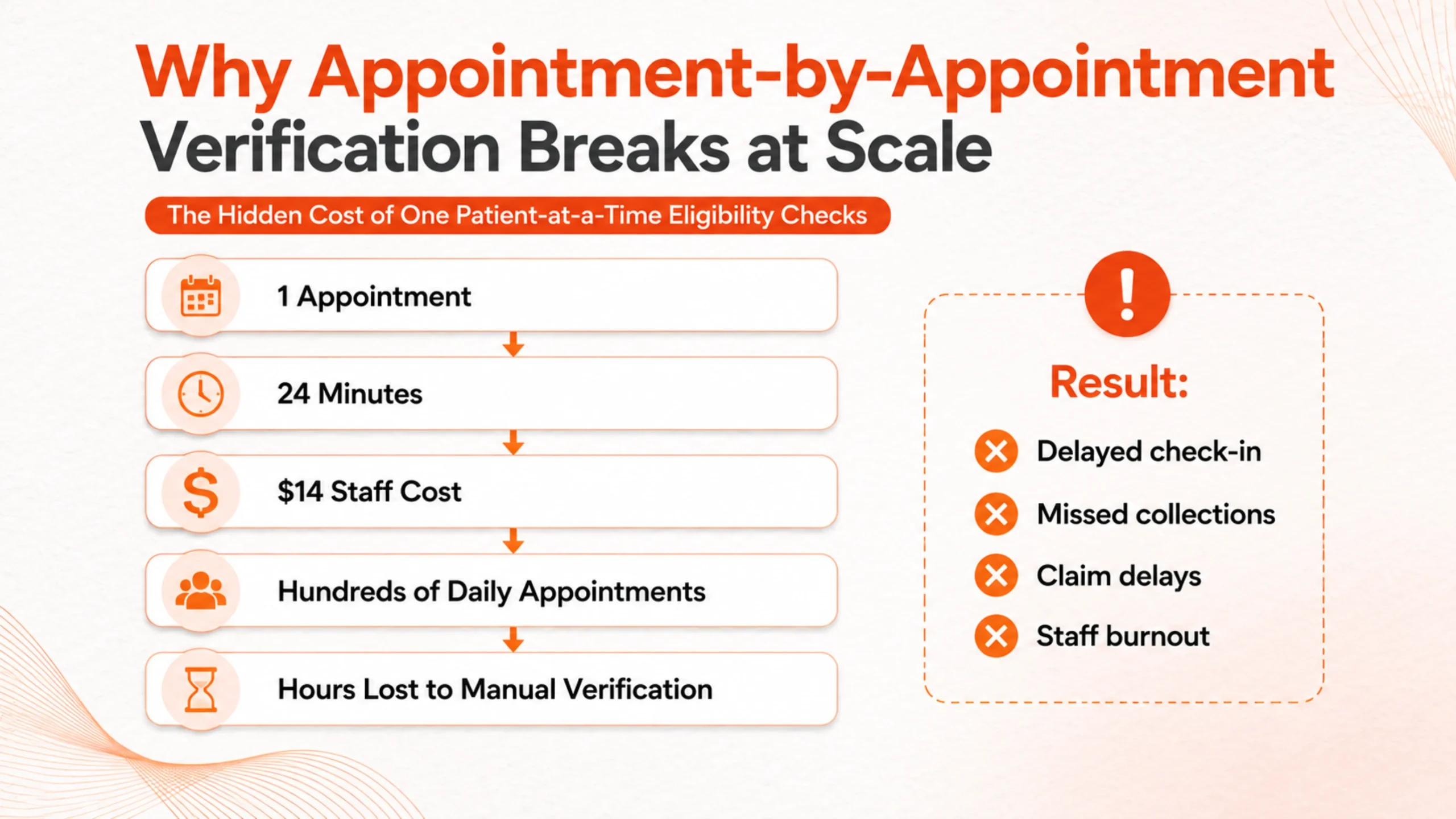
A single manual eligibility check is not an insignificant task. According to the CAQH Index, it costs practices 24 minutes and $14 in staff time. These numbers add up quickly when eligibility checks are performed one patient at a time in a reactive, day-of-appointment manner.
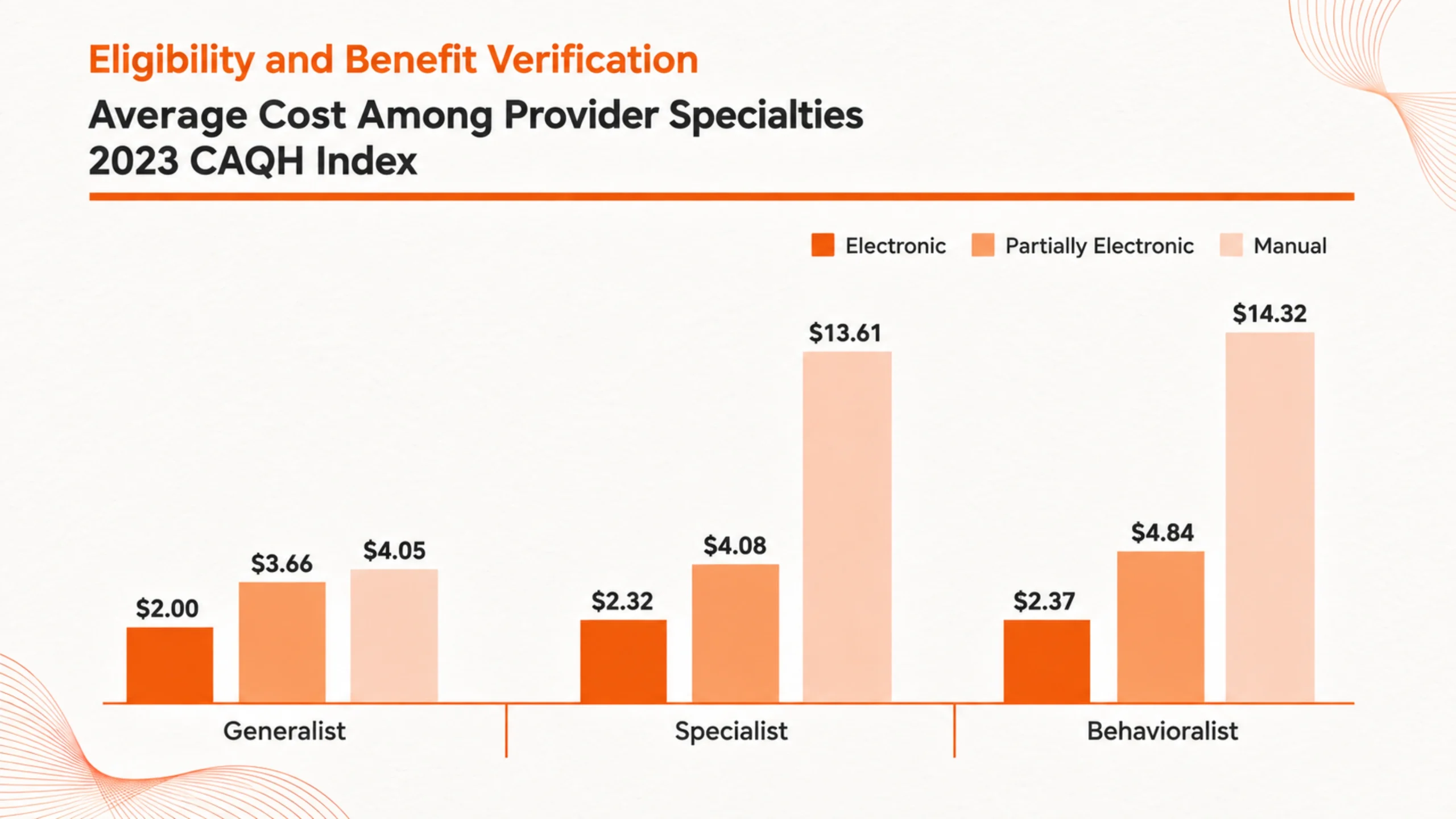
Eligibility and benefit verification transactions increased 60 percent to $43 billion in 2024, making it the administrative health care transaction category with the highest spending, despite the industry’s ongoing digitization efforts.
When staff members spend hours reviewing each scheduled patient, it creates less time to address the exceptions that impact reimbursement, such as inactive coverage, expired referral, prior authorization, coordination of benefits, or patient responsibility issues.
The end result is that exceptions that could be resolved before the day of service are often discovered at check in, causing registration delays, point of service collection misses, claim holds, denials and rescheduling
High volume practices require a change in their workflow in order to redirect staff members from spending hours reviewing each appointment to focusing on the exceptions that need correction before the day of service.
Where Appointment-by-Appointment Verification Creates Revenue Leakage
| Eligibility Issue | Operational Impact | Revenue Impact |
|---|---|---|
| Insurance changed | Registration delays | Eligibility-related claim delays |
| Deductible reset | Unexpected patient balance | Lower point-of-service collections |
| Missing secondary insurance | Manual rebilling | Delayed reimbursement |
| Referral expired | Appointment rescheduling | Lost provider productivity |
| Prior authorization missing | Claim rejection or denial | Appeals and payment delays |
| Incorrect subscriber information | Claim correction | Additional administrative work |
From Reactive to Proactive: How High-Performing Practices Handle Eligibility Verification
The MGMA member responses reveal that practices organize insurance eligibility verification based on their needs and resources. Some rely on billing teams, others hire dedicated eligibility specialists, distribute responsibilities across cross-trained staff, or leverage automation to process high appointment volumes .
- Bill Hambsh, CEO of North Florida Women’s Care, has his billing staff verify insurances three business days prior to appointments and reviewing their schedules for patients who may need additional follow-up.
- Steve Stout, Practice Administrator for APM&R, has two dedicated eligibility specialists who verify coverage four days prior to appointments, a change he notes has had a positive impact on their ability to collect outstanding payments.
- Dena Merrill, Administrator for Hill Country OB/GYN, uses a third-party eligibility tool to automatically batch process most eligibility information. She typically reviews exceptions manually, which takes about ten minutes.
- Jane Dodds of Women Gynecology & Childbirth Associates assigns eligibility verification to her cross-trained secretaries on a rotating basis, each working with their assigned physician and responsible for managing their own eligibility workflow.
- Crystal Miner of Denali OB/GYN Clinic has patient account representatives that are responsible for verifying benefits for surgeries and obstetrical services and informing patients of their financial responsibility before their visit.
- Paul LePage, Vice President of Revenue Cycle at UC Davis Health, described building a denial taxonomy that tied payer codes to operational ownership and stratified denials by preventability, financial impact, and overturn probability as the most effective strategy his team implemented
The MGMA members’ experience underscores the efficiency to be gained by moving eligibility verification to a batch process several days prior to the date of the appointment.
Their insights highlight one approach to creating a more efficient, predictable eligibility verification process, but what these practices have in common verifies best practices to consider in developing a similar process.
Stop Doing Eligibility Checks Manually in eClinicalWorks. Verify 100s of Patient Benefits In Minutes.
How Does a Batch Eligibility Workflow Improve Insurance Verification in eClinicalWorks?
A batch eligibility workflow changes the sequence of events. Instead of discovering problems when patients arrive, practices identify and resolve exceptions before the appointment date.
How Can Organizations Build Batch Eligibility Workflows Around eClinicalWorks?
As patient volumes rise, ad-hoc eligibility checks at the time of each appointment become unwieldy. According to the 2024 CAQH Index, US medical providers carried out over 25 billion electronic eligibility and benefits verification transactions nationwide in 2024.
This makes eligibility verification one of the highest-volume administrative processes in healthcare. At the same time, healthcare providers retain an opportunity to realize over $11.5 billion in annual savings through automating eligibility and benefits verification.
Since eClinicalWorks does not support batch eligibility verification out-of-the-box, high-volume practices typically employ one of the three methods below to scale and accelerate their pre-visit verification operations:
- Partner with an eClinicalWorks-Experienced Eligibility & Benefits Verification Services Vendor
It is crucial for eCW organizations to partner with an eligibility verification services vendor that has extensive experience supporting eClinicalWorks workflows.
These vendors typically provide:
- Automated pre-visit eligibility verification for upcoming appointments
- Benefits verification to confirm patient financial responsibility
- Eligibility exception management with manual follow-up only when needed
- Referral and prior authorization support where required
- Integration with existing eCW workflows to minimize operational disruption
Key benefits include:
- Reduced manual eligibility verification workload
- Faster, exception-based processing
- Fewer eligibility-related claim denials
- Improved front-office productivity
- Better patient financial transparency before the visit
- No need to build or maintain internal automation
By leveraging an eClinicalWorks-experienced E&B verification partner, practices can scale pre-visit eligibility operations, improve revenue cycle efficiency, and help ensure patients arrive with verified insurance coverage.
- Automate Patient Eligibility Verification Internally
Most large practices and healthcare systems that rely on eClinicalWorks develop internal automation to extract schedules into a separate eligibility verification layer using their limited internal IT resources.
By applying robotic process automation (RPA) or other forms of internal automation to eClinicalWorks’ scheduling data, these organizations generate eligibility worklists, perform automated eligibility verification where possible, and identify exceptions for manual follow-up.
The approach typically maximizes flexibility but requires significant technical resources to develop and maintain in-house, including continuous payer rule updates.
- Clearinghouse-Based Automation Using HIPAA 270/271 EDI
Some practices tackle the challenge by using a clearinghouse’s advanced processing capabilities to carry out eligibility verifications against the provider’s entire schedule of upcoming visits.
By issuing standardized HIPAA 270/271 eligibility transactions and receiving detailed transaction responses, such practices carry out extensive automated verification while reducing manual follow-ups.
It is a highly efficient method, but one that depends on the capabilities of a specific clearinghouse, payer participation, and the ability to integrate its results back into the practice’s eClinicalWorks workflows.
| Approach | Pros | Cons | Best Fit |
|---|---|---|---|
| eCW-Experienced Eligibility Verification Services | End-to-end pre-visit eligibility verification, benefits verification, exception management, rapid deployment, minimal internal effort, reduced denials, and improved staff productivity. | Requires selecting an experienced vendor with proven eClinicalWorks expertise. | Practices seeking to scale eligibility verification quickly without investing in internal automation. |
| Internal Automation | Complete control and customization. | High IT investment, ongoing maintenance, and payer rule updates. | Large health systems with dedicated automation teams. |
| Clearinghouse-Based Automation | Automates HIPAA 270/271 eligibility transactions and reduces manual checks. | Depends on clearinghouse capabilities, payer participation, and integration. | Practices leveraging advanced clearinghouse infrastructure. |
Save 10+ Hours Every Week on Eligibility Checks!
Let Automation Handle the Eligibility Checks
How to Build a Batch, Day-of-Clinic Eligibility Workflow in eClinicalWorks
Building a batch eligibility workflow in eClinicalWorks is not about yet another verification step, it’s about connecting eCW workflows in a proactive pre-visit process.
Most practices have the key elements needed: the schedule, patient demographics, insurances, eligibility connectivity, referral workflow, authorization tracking, and task follow up capabilities. It’s about organizing them around the schedule rather than verifying patients individually at the day of care.
An effective eClinicalWorks eligibility workflow has one core principle:
Review the schedule early → Run eligibility checks in batches → Route exceptions → Resolve issues before the patient arrives.
Such a workflow can be implemented across primary care, specialty, and multi-provider organizations using eClinicalWorks.
Two Ways to Build a Batch Eligibility Verification Workflow in eClinicalWorks
Outsourced Model – An external eligibility team handles verification, payer follow-up, and exceptions via secure connectivity to eClinicalWorks.
Internal Automation Model – Eligibility technology integrated with eClinicalWorks processes appointments automatically; the practice still owns exception resolution.
The key difference: who interprets payer responses and resolves coverage issues, not just how the check runs.
Option 1: Outsourced Batch Eligibility Verification
Through an outsourced model, the existing eClinicalWorks workflow is extended with dedicated eligibility specialists who manage pre-visit verification activities.
The outsourced eligibility team functions as an extension of the revenue cycle operation, with verification, payer review, and exception follow-up completed before the patient arrives.
Step 1: Connect Appointment Data
A secure connection (API, HL7, SFTP, or worklist export) shares appointment data into a daily work queue for the specialist team:
- Demographics, DOB
- Visit/provider/payer details
- Member ID, group number
- Referral/authorization status on file
Referral and authorization fields here are whatever’s currently in eCW, not yet payer-confirmed. They prioritize the queue; final confirmation happens in Step 3.
Step 2: Run Batch Eligibility Checks
eCW Schedule → Work Queue → Payer Portal/Manual Verification→ Coverage Confirmation
A dedicated specialist calls the payer directly for each account in the queue and confirms:
- Coverage status
- Effective/termination dates
- Benefits, copay, deductible, coinsurance
- Coverage limitations
This confirms coverage only, not authorization or referral requirements. Those are checked separately in Step 3.
Step 3: Human Validation
The same specialist reviews the payer’s verbal confirmation and validates on-file auth/referral status directly with the payer on the same call:
- Correct plan identified?
- Active on date of service?
- Another payer primary?
- Auth/referral still valid with payer?
- Benefit restrictions?
Step 4: Categorize and Resolve Exceptions
| Exception | Resolution Action |
|---|---|
| Inactive insurance | Patient outreach to confirm coverage |
| Insurance mismatch | Payer info validated |
| Missing/invalid authorization | Coordinated with payer |
| Missing/invalid referral | Communicated to patient/provider |
Step 5: Pre-Visit Follow-Up
Outreach, benefit clarification, and referral/auth confirmation are completed before the visit, reducing front-desk surprises.
Option 2: Automated Batch Eligibility Verification
Step 1: Configure Integration
eCW connects to the automation platform via API, HL7, integration engine, or extract, pulling new appointments/visits, insurance, demographics, provider, and visit info.
Step 2: Import & Validate, Then Auto-Submit
eCW Schedule → Export/Get Appointments → Import into Automation Platform → API/HL7 Submission → Payer → 271 Response
- If import is unsuccessful, the team is notified of the import error; staff update the source data and release it back for processing.
- If data is imported, the record moves into E&B verification via RPA/API against the payer (X12 270/271).
As in Option 1, this covers coverage/benefits only; auth and referral status need a separate lookup (e.g., 278 inquiry or payer-portal integration) if the platform supports it.
Step 3: Check for Additional Benefit Information Needed
E&B Verification (RPA/API) → Need more benefit info than electronically collected?
- If Yes, a staff member manually looks up and updates the information, then releases it back for reprocessing (loops back into E&B verification).
- If No, the source system (eCW) is updated directly with the benefit information, and verification is complete.
Step 4: Route Exceptions
| Exception | Internal Owner |
|---|---|
| Insurance update needed | Registration team |
| Authorization missing/invalid | Authorization team |
| Referral missing/invalid | Referral team |
| COB problem | Billing team |
| Demographic mismatch | Front desk |
Patient outreach isn’t its own exception, it’s a resolution action that spans several categories above, typically handled by front desk or registration.
Step 5: Resolve Complex Cases Internally
Payer calls, conflicting coverage, missing referrals, auth confirmations, and benefit explanations remain the practice’s responsibility.
Why eCW Practices Often Prefer Outsourced Eligibility Verification?
Automation cuts repetitive checks, but most real friction such as authorization gaps, referral issues, coverage disputes, happens after the 271 comes back, outside what the transaction itself confirms.
A managed model pairs eCW connectivity with human interpretation and follow-through, turning eligibility from a coverage check into full pre-visit readiness: fewer check-in delays, fewer avoidable denials, better revenue cycle performance.
Are Coverage Issues Still Appearing at Patient Check-In?
Outsource pre-visit eligibility verification to experienced eClinicalWorks professionals and resolve issues before the day of service.
How Much Time and Cost Could a Batch Eligibility Workflow Save?
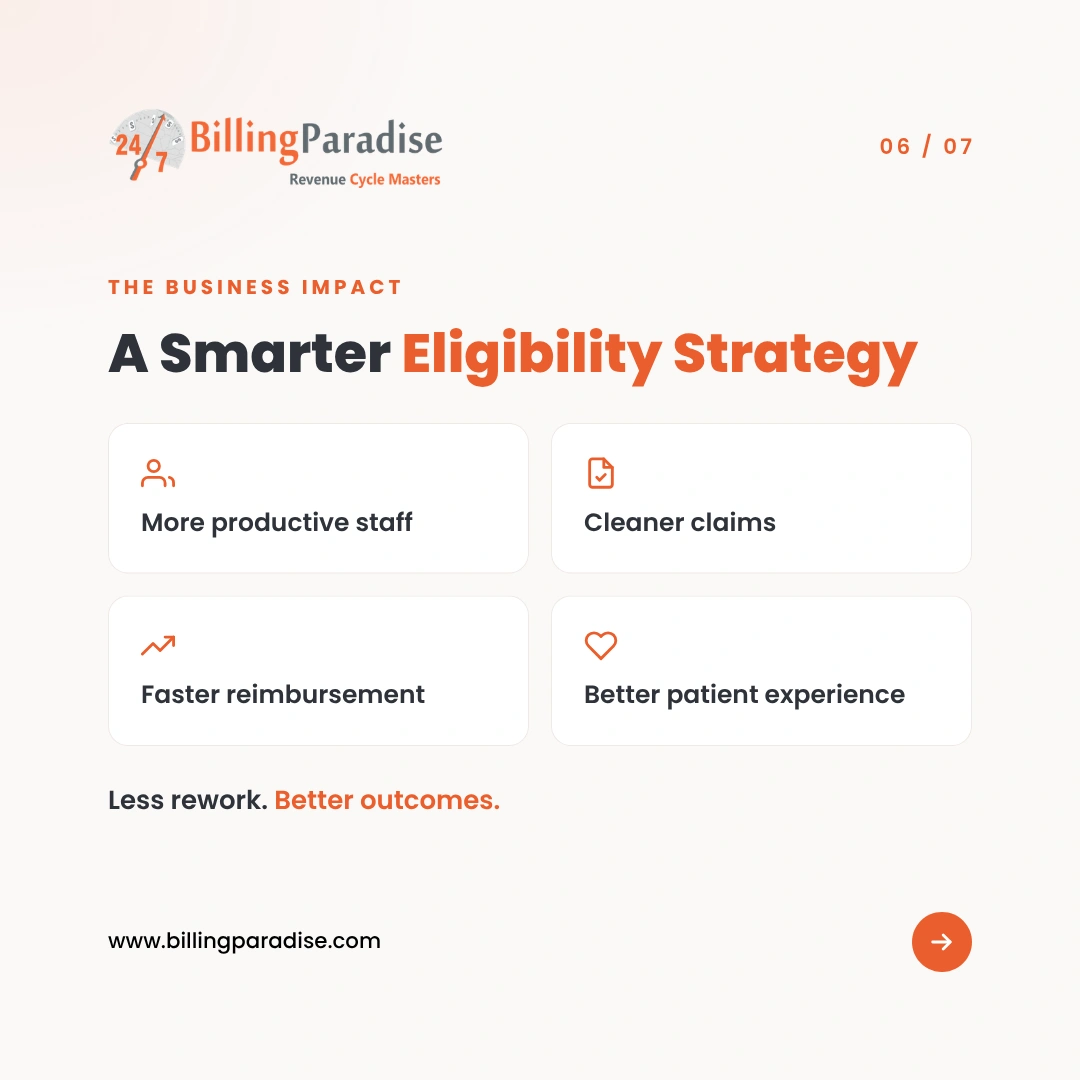
By implementing a batch eligibility workflow, a practice can recover significant administrative capacity by moving away from manual, appointment-adjacent eligibility checks.
The calculation below represents an illustrative scenario only. Depending on labor costs, payer mix, volume of visits, and other factors, the impact could easily be higher or lower.
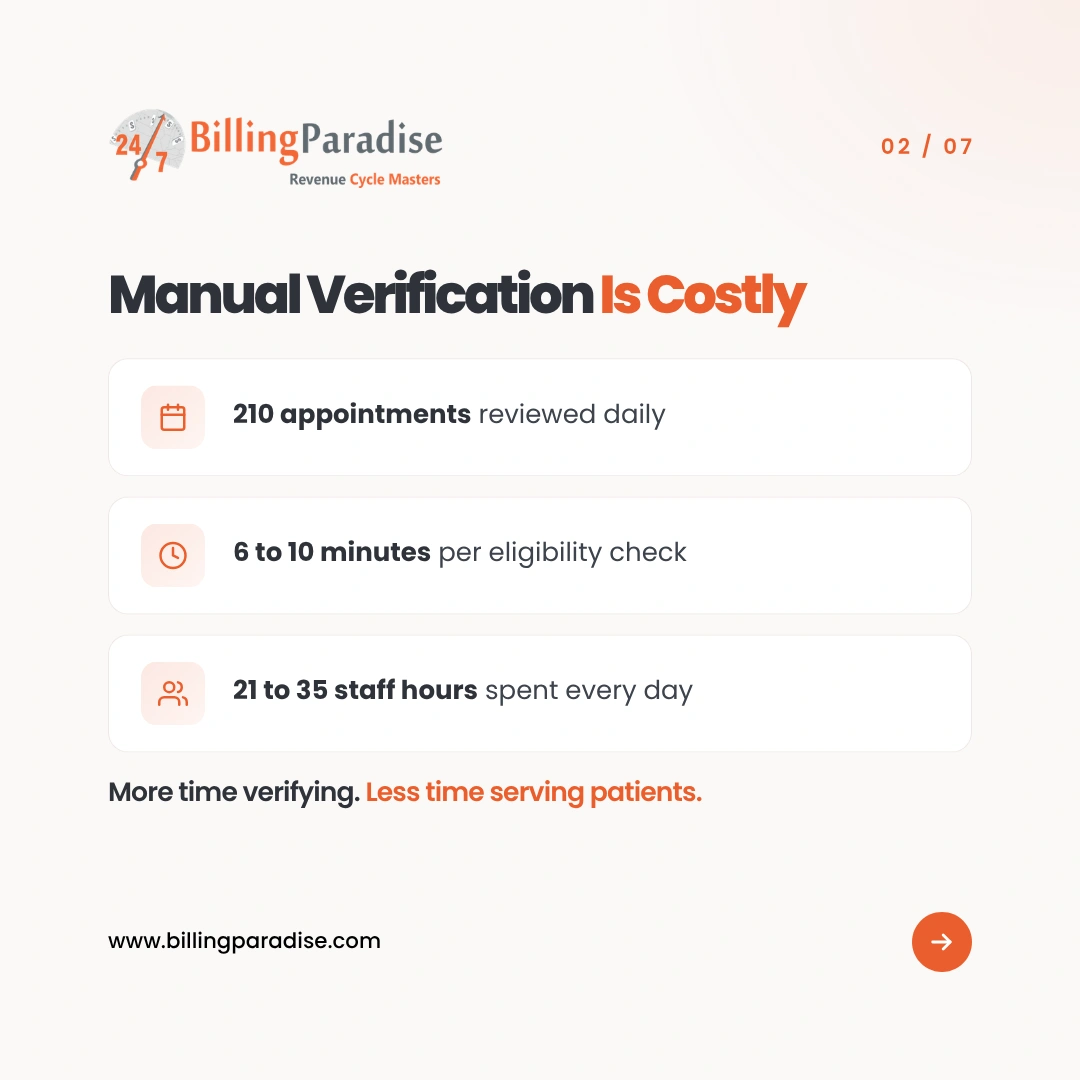
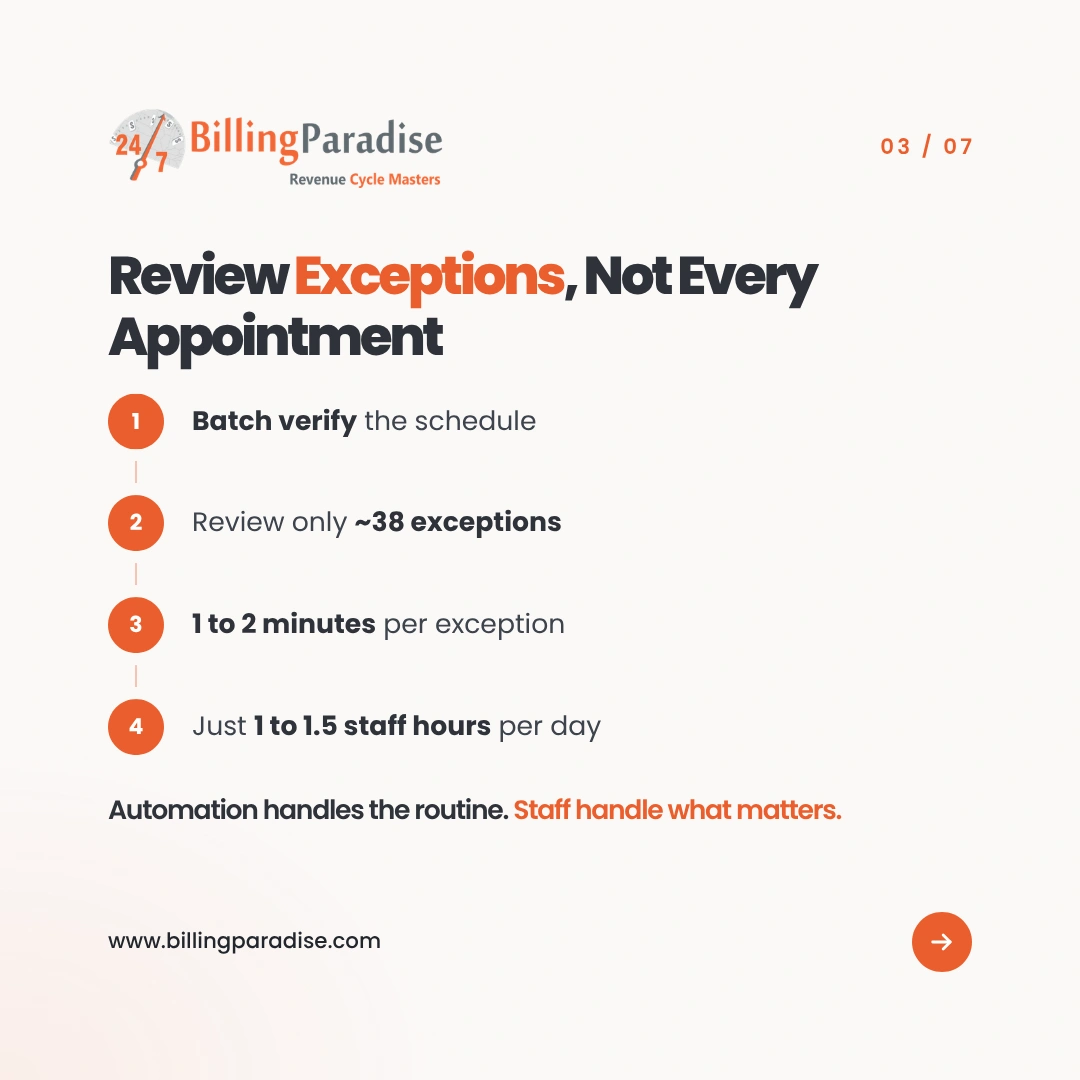
| Workflow | Current Process | Batch Eligibility Process |
|---|---|---|
| Appointments reviewed | 210 | ~38 exceptions |
| Average review time | 6–10 minutes per appointment | 1–2 minutes per exception |
| Estimated daily verification effort | 21–35 staff hours | 1–1.5 staff hours |
| Primary workload | Manual verification | Exception resolution |
Illustrative Labor Cost Savings:
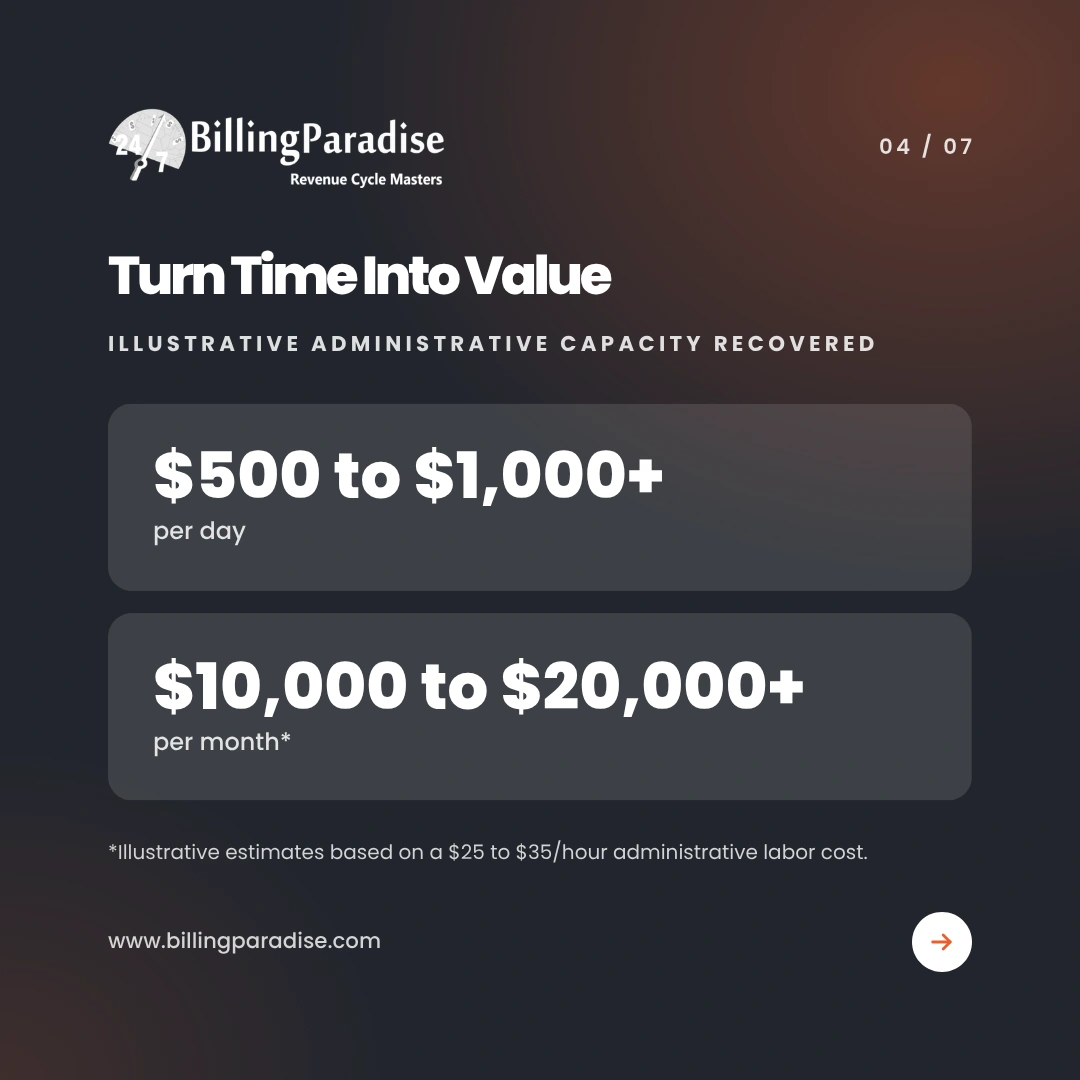
Let’s assume $25-$35/hour represents the labor cost for an administrative position. Eliminating these tasks would represent:
- $500-$$1000+ of daily administrative capacity
- $10,000-$20,000+ of monthly administrative capacity (based on 20 days/month)
These are figures representing recovered staff capacity, not direct costs saved by reducing eligibility verification. The true financial impact will depend on how the practice chooses to allocate this recovered administrative capacity.
Revenue Cycle Impact
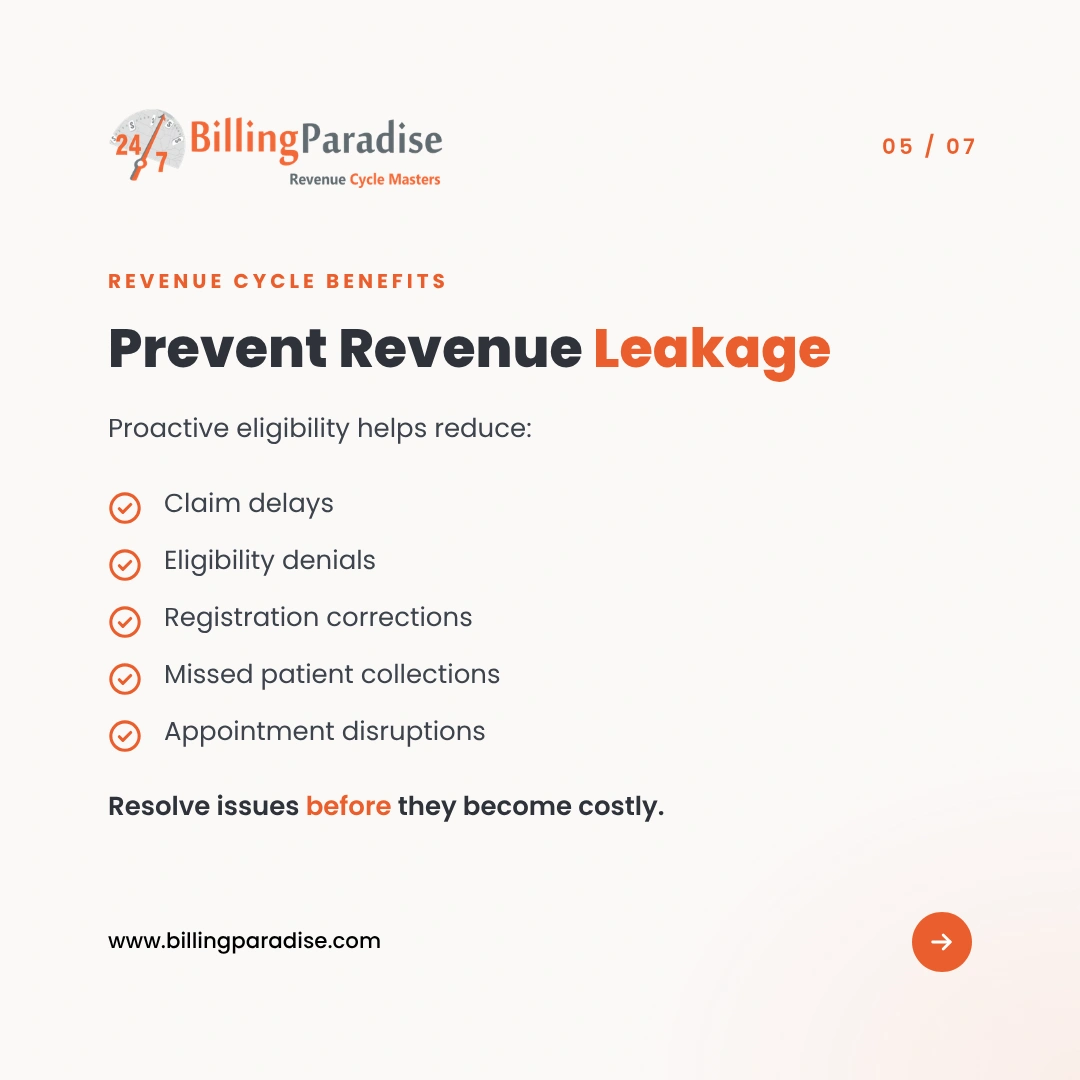
Beyond the direct labor cost savings, proactive eligibility verification will help minimize the downstream revenue cycle impact of coverage issues, including:
- Eligibility claim delays
- Unnecessary denials
- Same-day registration corrections
- Missed patient responsibility collection opportunities
- Appointment delays due to unresolved coverage issues
The financial benefit of a batch eligibility methodology is not limited to the cost savings of reduced manual verification.
By detecting and resolving coverage issues early you avoid the downstream costs and lost productivity associated with denied claims, collection delays, and appointment rescheduling.
60+ Hours/Week Spent on Eligibility Checks? See What Automation Can Save.
Find out your current verification workload and compare it with an automated eligibility workflow.
Moving Toward a More Proactive Eligibility Workflow in eClinicalWorks
For eClinicalWorks practices, the next frontier in eligibility management is less about getting through one more appointment and more about streamlining the process itself.
A batch day-of-clinic workflow allows practices to take a proactive approach to managing their eligibility verification process, identify exceptions sooner, and reduce the number of issues that require staff intervention.
Whether through internal processes or with an experienced eCW revenue cycle partner, it’s all about spending less time on repetitive tasks and more time ensuring a smooth day-of-clinic flow while allowing staff to spend more time on patient care and true revenue cycle exceptions.
The future of eligibility verification is less about verifying each appointment and more about having a proactive, schedule-based process that highlights exceptions and reduces unnecessary interventions.
Providers are taking too long to get credentialed and start billing?
Talk to BillingParadise’s credentialing specialists about optimizing Medicare, Medicaid and commercial payer enrollment processes to reduce payer approval delays and accelerate provider reimbursement.
Get Credentialed FasterFrequently Asked Questions