

Becker’s Annual Health IT + Revenue Cycle Conference 2020, an ongoing series will be held from 13-16th Oct, 2020 at Navy Pier, Chicago, many healthcare leaders participate at the conference, which is organised by Becker’s.
Patrick Woodward, Chief Medical Information Officer for Renown Health will serve on the panel “The Best Uses of Health IT for Clinical Improvements” at Becker’s Annual Health IT + Revenue Cycle Conference.
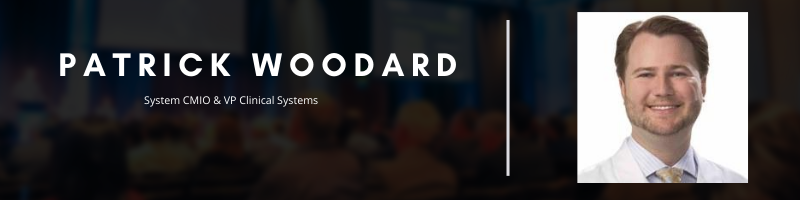
Patrick Woodard, MD, MHA, serves as Chief Medical Information Officer & Vice President, Clinical Services for Renown Health.
On October 15th, Dr. Woodard will serve on the panel “The Best Uses of Health IT for Clinical Improvements” at Becker’s Annual Health IT + Revenue Cycle Conference. As part of an ongoing series, Becker’s is talking to healthcare leaders who plan to speak at the conference, which will take place October 13-16, 2020 at Navy Pier, Chicago.
Becker’s had three questions for Dr.Woodward, the Q&A session that was related to the conference provides a brief summary of the topic on which the speakers are going to speak in length during the conference.
Question: What technology has taken on greater significance or value during the pandemic?
Patrick Woodard: Without a doubt, virtual care is the winner of the coronavirus pandemic. Like many health systems, our team made marked strides in our ability to see patients via telemedicine and video visits, whether in acute care, the emergency room, urgent care, or the primary care office.
It has also brought to light some of the inequities that already existed. Like students whose financial inequality is exposed by online classes, our most vulnerable patients—those who need our care the most—are those least likely to be able to use this technology. As a physician, I can recall dozens of patients who would pull out a flip phone for an impromptu family conference call. Our next task, as health systems and as a country, is to make sure we do not leave anyone behind just because they do not have access to the tools we believe are commonplace.
Q: How has the coronavirus pandemic forced a paradigm shift in your line of work, from your perspective?
PW:For the first time, the pandemic has given us the opportunity to really think in a patient-centered way without distraction. This means things like virtual visits, expanded online scheduling, digital waiting queues, and improved technical support. These have been our goals for quite some time, but other priorities have always bubbled to the top. But as our operations fundamentally shift to digital formats, we have had to rapidly accelerate our ability to meet patients where they are.
We created change in the last month that outpaced prior change at an almost incomprehensible scale. Our work was focused. But the real silver lining is that we were forced, as a system, to think from our patients’ perspectives. We were able to look at our patients’ needs without consideration of the difficulty to operationalize it.
Q: What is the most underrated trait of the best leaders?
PW: This is a very timely question. A colleague and I were discussing just the other day that a well-formed emotional intelligence is a necessary trait for a great leader, but one we both thought often gets overlooked. It helps that the next day I read three great articles about the need for humanity, especially in a crisis. If we are expressing our vision but not connecting with our people, we’re fundamentally missing the mark.
I suspect we have all had experiences with leaders who express a vision but cannot connect with their staff. I’m very fortunate to now be able to experience the full package. My own leader is phenomenal at reading his employees’ needs and responding appropriately, and he has inspired me to do the same. Connecting with my own staff and understanding their needs has helped me to better understand my own and remain connected to our organization, my own goals, and my team. That emotional connection helps not just connect with the vision, but also to express the depth and logic behind it and remember that an organization is nothing without its people.


