Table of contents
Why It Is Not Too Late to Adopt a Medical AI + Coding Staff Hybrid Model
Q3 2025: Your Strategic Moment to Act
By Q3 2025, the Medical AI coding hybrid model is no longer experimental; it’s a mature, proven way to handle your revenue cycle. With technology reliability improving and payer acceptance growing, now is the time to adopt.
Industry data shows:
- About 46% of hospitals already use AI in their revenue cycle, and 74% use automation tools like RPA.
- Organizations leveraging AI saw 30% ROI, 40% faster documentation, and 99.5% accuracy.
- Up to 80% of medical bills contain errors, and 42% of denials are due to coding issues.
So yes, you’re not too late. Your peers are already moving, and the hybrid medical coding solutions model is becoming the standard.
What Has Changed Since 2023–2024?
Several shifts have made adoption now more viable and urgent:
- Regulatory clarity is growing, with OIG and DOJ focusing on oversight and insisting on human-in-the-loop processes.
- ICD-11 adoption, increased payer scrutiny, and higher denial risk make pure human or pure AI coding risky.
- Tech has matured: AI models now understand clinical context better; platforms embed audit trails and feedback loops.
Why You Can Still Lead (Even If You Haven’t Started Yet)
- “Fast follower advantage”: Learn from peers like Cleveland Clinic and Stanford Health Care without the pilot pain.
- Health systems automated 60–70% of workflows, saved 15,000 hours per month, reduced denial rates, and achieved 30% ROI.
- Cleveland Clinic’s collaboration with AKASA shows generative AI tools now process over 100 clinical documents in under two minutes with human oversight for nuance.
- You can enter now with proven blueprints, avoiding trial-and-error early adopter mistakes.
What Is Medical Coding AI + Staff Hybrid Model?
Definition & Core Concept
You might wonder: what exactly is a Medical AI coding hybrid model? Simply put, it combines:
- AI-powered coding automation for routine, high-confidence charts
- Certified human coders for ambiguous, complex cases, validation, and exception handling
Think of it as “AI does high volume and speed; staff bring judgment and compliance.” This hybrid medical coding solution balances efficiency, accuracy, and risk management, harnessing the best of both worlds.
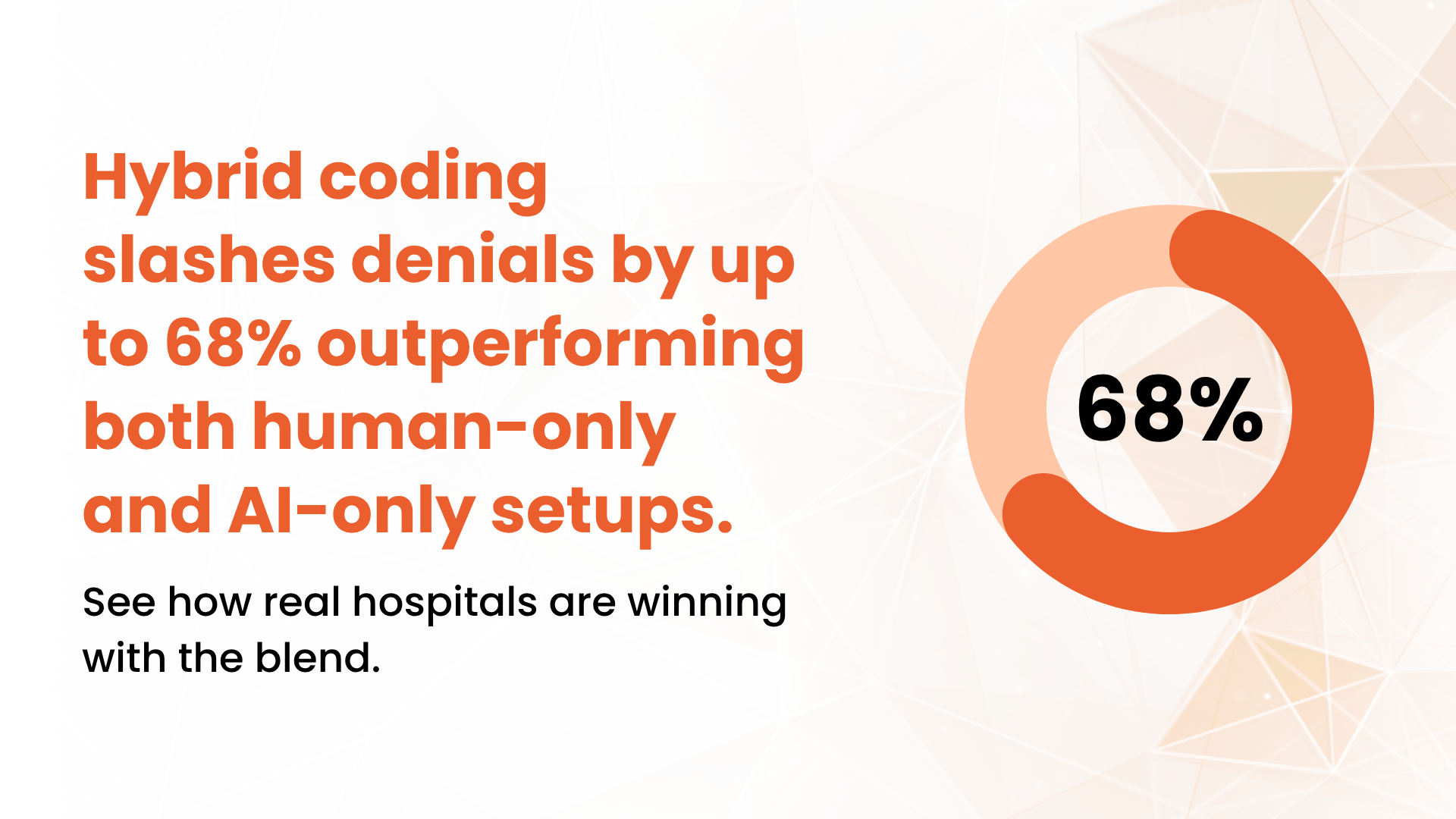
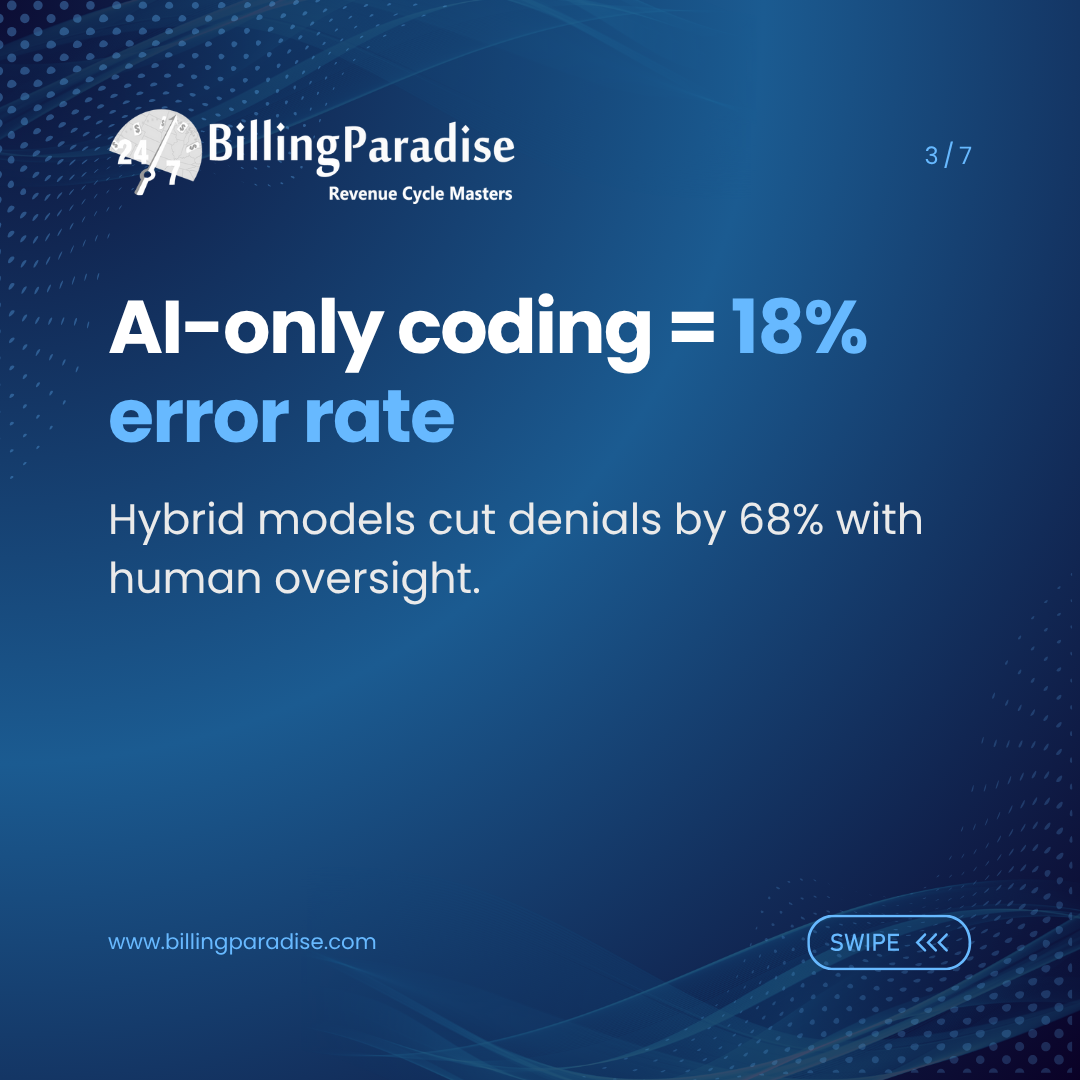
Recent industry data highlights that hybrid teams can achieve over 99% coding accuracy, cut denial rates by up to 68%, and lower costs by about 30% compared to human-only workflows.
How the Workflow Operates in Practice
Here’s how a typical Medical AI coding hybrid model works inside your revenue cycle:
- AI tool scans charts
It uses NLP and machine learning to assign ICD, CPT, HCPCS codes based on historical patterns and terminology. - Confidence threshold applied
High-confidence codes are auto-posted; low-confidence or flagged cases go to human review. - Human coder validation
Coders audit flagged cases, add clinical insight, and ensure compliance before final submission. - Continuous feedback loop
Human corrections inform AI learning, improving accuracy over time, especially in rare or nuanced conditions.
Why It Works Better Than AI‑Only or Human‑Only Solutions
- Human-only coding:
- Error-prone for high volumes.
- Slower turnaround (often 40% slower than hybrid).
- High burnout and turnover due to volume and complexity.
- AI-only coding:
- Misses clinical nuance, with error rates of 12–18% in complex cases.
- High risk of denials and payer non-acceptance without human validation.
The hybrid model addresses these issues head-on by blending AI’s speed with human quality control.
Pain Points You Likely Face & Hybrid Model Solutions
Pain Points:
- Persistent denial rates due to coding inconsistencies
- Staff burnout, turnover, and training costs
- Revenue loss from undercoding, rescans, and claim rework
How Medical Coding AI+Staff Hybrid Model Helps:
- With denial management AI, you can detect denial patterns early and flag at-risk charts before they leave your RCM system.
- Using expert denial management services includes AI-driven workflows and human staff support to fix and prevent coding errors, helping reduce denial rates by 50–68%.
- This creates measurable ROI in your hybrid coding model by both reducing rework and improving clean claim rates.
Why the AI + Human Coding Model Is Essential for Healthcare Organizations in Q3 2025
Why You Need Hybrid Medical Coding Solutions Now
You’re likely asking yourself: “Why is the Medical AI and staff coding hybrid model essential in Q3 2025?” The answer is simple: you’re facing greater compliance risk, rising denial rates, and pressure to optimize your revenue cycle while keeping human oversight intact.
Today, denial rates are climbing and coding issues account for 40–80% of billing errors, crushing your clean-claim rates and costing you time and money. Yet organizations using hybrid medical coding solutions report first-pass acceptance rates of 95%+ and denial reductions of 40–50% within a year, thanks to AI flagging errors early, with human review closing the gap.
That’s why this AI medical billing tool for Q3 2025 isn’t optional it’s essential to protect revenue, ensure compliance, and scale without sacrificing quality.
The Key Drivers Making Hybrid Coding Critical Today
Compliance & Regulatory Oversight
Increasing guidance from agencies like OIG, DOJ, and payers mandates human-in-the-loop validation for AI-generated codes. You can’t rely solely on automation without real accountability.
Denial Risk & Financial Leakage
Claim denials, often due to coding inaccuracies, are up 20% since 2016. Improving accuracy via a hybrid model directly protects revenue.
Staff Burnout and Workforce Constraints
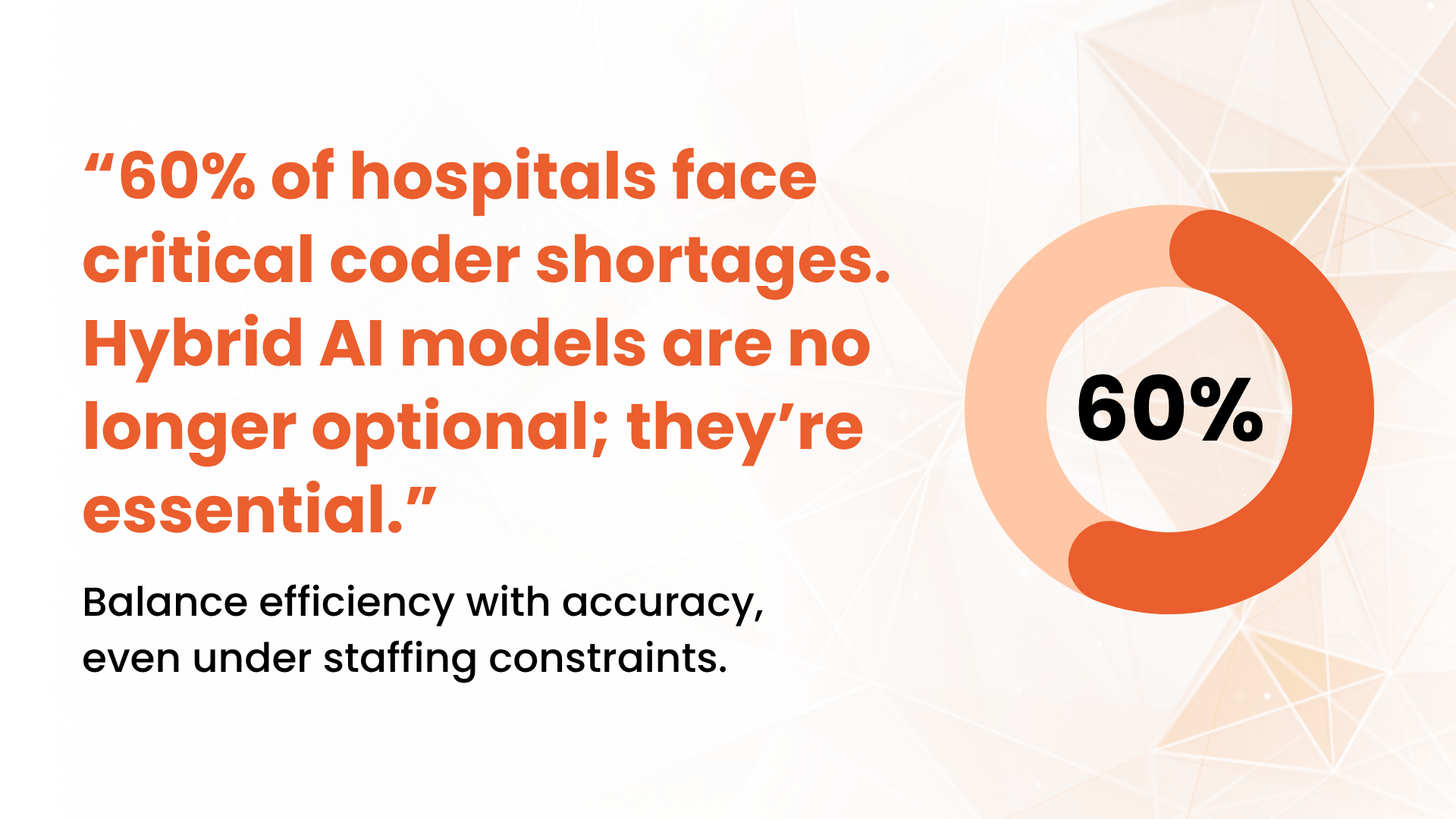
Coder turnover is high. Human-only coding is 40% slower and struggles under ICD‑11’s complexity. By shifting routine tasks to AI, you free up staff for exception handling and auditing.
What Hybrid Delivers: Metrics & Benefits You Can’t Ignore
Here’s how the benefits of hybrid AI and staff model in RCM stack up:
- Accuracy: Hybrid setups achieve 99%+ coding accuracy, beating both human-only and AI-only models.
- Denials: Experience up to 50–68% reduction in coding-related denials via early AI detection and human correction.
- Productivity: Staff productivity rises 30–65% when their focus shifts from routine coding to nuanced audits and exceptions.
- Revenue Capture: Some practitioners record mid-20% increases in net collections and saw accounts receivable days shrink by 20–35%.
Using hybrid coding also protects you from compliance risk while enabling scale and cost optimization.
Real-World Social Proof & Leadership Insight
You’re not alone in recognizing that the workforce is evolving.
As Salesforce CEO Marc Benioff said at Davos: “CEOs will be the last generation to oversee entirely human workforces. A hybrid human and AI workforce is coming.”
That includes medical coding teams; you need AI, but you also need human oversight.
Even Sam Altman of OpenAI remarks that despite AI’s diagnostic advantages, “trust and human connection still win.”
Emphasizing why you need humans in the coding loop for transparency and accountability.
How This Supports Your Hybrid Advantage
You face denial and coding risks every day. Here’s how the denial management services and AI tools help:
- Denial Management AI: Proactively flags likely denials based on coding patterns before the claim is submitted, reducing rework and increasing odds of clean claims.
- Denial Management Services: A team of experienced coders reviews and appeals flagged claims, achieving denial reduction rates of 50–68%.
Integrated into your Medical AI coding hybrid model, this combination ensures that AI flags issues early and your human team validates or corrects, maximizing efficiency and accuracy, while aligning with payer and regulatory expectations.
The Limitations of Human‑Only Medical Coding
Why Pure Human Coding No Longer Works
You may still rely on an all-human coding team, but in Q3 2025, that model is highly vulnerable:
- Around 66% of health information departments report understaffing over the past two years.
- The AAPC estimates a 12% nationwide coder shortage, leading to unmanageable workloads, slowed coding, burnout, and increased errors.
- Medical coding error rates remain sky-high: the American Medical Association reports 80% of claims contain billing errors, and 42% of denials stem from coding mistakes.
Pain Points You’re Facing Right Now
You’re contending with:
- High denial rates due to coding inconsistencies and incomplete documentation.
- Revenue leakage and rework, with significant costs per rescanned or resubmitted chart.
- Coder burnout and turnover, as staff juggle complex ICD‑11 requirements without adequate support.
- Slow coding turnaround, delays in claim submission, and growing accounts receivable days.
These issues don’t just affect productivity; they directly undermine your organization’s bottom line.
Real-World Example: Human‑Only Model Failure
At many hospitals, clean claim rates stagnate because coding staff are overwhelmed:
- Hospitals relying solely on human coders often struggle to reach 95% first-pass acceptance.
- Coder turnover and consistent understaffing result in longer cycle times, greater discrepancy rates, and reduced net revenue.
- Without automation, diagnosis nuances and modifier errors slip through, leading to frequent denials.
Why You Need the Medical AI Coding Hybrid Model Instead
Transitioning from human-only to a Medical AI coding hybrid model addresses these challenges:
- Automation for Routine Work
AI handles high-volume, clear-cut cases, reducing workload and limiting manual errors. - Human Oversight for Complex Cases
Staff focus on edge cases, documentation clarity, and compliance areas where judgment beats automation. - Feedback Loop to Improve Accuracy
Human corrections feed back into the AI, helping it learn uncommon coding patterns and reduce future errors.
Together, this creates a balanced, resilient workflow that scales without sacrificing quality or compliance.
How It Helps Fix Human-Only Drawbacks
Denial management services and AI tools are designed for your exact challenges:
- Their denial management AI identifies coding error patterns before claims are submitted, reducing denials proactively.
- Denial management services provide human expertise to review flagged charts and appeal or correct them, leading to denial reduction rates of 50–68%.
- Embedding these tools into your medical AI coding hybrid model boosts clean-claim rates, minimizes coder workload, and yields measurable ROI without sacrificing accuracy or compliance.
Why Fully Automated Medical Coding Still Falls Short
Why AI-Only Coding Isn’t Enough
You might ask: “Can pure AI meet your coding needs today?” Evidence suggests it often falls short, especially when clinical nuance, compliance, and accuracy matter most.
Automated systems still deliver error rates between 12–18% for complex charts, leading to higher denials and uncovered revenue gaps. A Mount Sinai study showed even state-of-the-art LLMs consistently miscode from a dataset covering more than 27,000 diagnosis and procedure codes, with poor performance on rare codes and complex combinatorial cases.
That’s why relying solely on an AI medical billing tool in Q3 2025 leaves you exposed to denials, compliance risk, and missed reimbursement.
Technical & Operational Limitations of AI in Coding
- Struggles with contextual reasoning and rare codes: Large language models often overfit to common scenarios, failing where clinical context matters most, leading to overstated confidence in incorrect codes.
- Incomplete training datasets and bias: AI tools underperform when coding unusual cases or specialties, partly due to gaps in benchmark datasets and poor clinical alignment.
- Data quality issues: AI accuracy depends on clean, structured input, yet clinical documentation often includes abbreviations, grammar errors, and incomplete information a major barrier to reliable automation.
Financial & Compliance Risks from AI-Only Systems
- Significant revenue loss: Mid-size hospitals relying on full automation can lose over $250,000 annually, with denials increasing by 15%, and correction costs consuming an additional $175,000 in labor.
- Regulatory pushback: OIG and DOJ caution against unmonitored AI automation. Without human oversight, you risk opaque results during audits or payer scrutiny.
Leadership Perspective on Hybrid Necessity
Experts emphasize that AI must be held in human hands.
Stanford Health Care notes, “Healthcare systems will still need to keep humans in the middle of medical billing and coding automation. There are real advantages of AI … but it’s not a substitute for human expertise.”.
That insight reflects the essential truth: AI accelerates volume and consistency but human judgment remains the guardrail.
How The Model Mitigates AI-Only Shortcomings
It Brings balance to the extremes of human-only and AI-only coding:
- Their denial management AI flags defects or high-risk charts before submission, cushioning potential error impact early in your workflow.
- Their denial management services offer human review of flagged items, appeals filing, and root cause remediation, delivering denial reduction rates of 50–68%.
- Embedded in your medical AI coding hybrid model, this approach ensures that AI handles high-volume routine tasks, while your human team reviews exceptions, combining efficiency, accuracy, and regulatory alignment.
How the Hybrid Model Solves Both Problems
How the Hybrid Model Bridges the Gap
The medical AI coding hybrid model reconciles the limitations of both all-human and all-AI systems. It does so by combining AI for speed and scale with human oversight for judgment and compliance, delivering the efficiency of automation and the accuracy of expert review.
Twin Forces Working in Harmony
- AI handles routine volume with precision
A well-tuned AI engine can process thousands of charts in minutes with over 98% accuracy for straightforward cases, meaning human staff are freed from routine tasks to focus on higher-value work. In fact, hybrid teams report 99.1% coding accuracy while costing 30% less than human-only approaches. - Human coders tackle complexity and exceptions
Coders intervene when confidence thresholds drop or documentation is ambiguous, bringing clinical insight to ensure clean, compliant claims. And with AI freeing them from repetitive coding, burnout plummets. - Over time, the AI improves through feedback loops
Human corrections are fed back into the system, sharpening AI accuracy over time, especially for rare or complex cases that might trip up standalone models.
The Impact of Hybrid in Healthcare RCM
| Metric | Human‑Only | AI‑Only | Hybrid Model |
| Coding Accuracy | 95% | 82–88% in complex cases | 99%+ |
| Denial Rate Reduction | Modest (≤20%) | Moderate (30%) | 50–68% denial reduction |
| Productivity | Baseline | High volume speed | 30–65% staff productivity boost |
| Retention & Satisfaction | Stress, fatigue | Overautomation risk | Coders stay 2.3× longer |
These results underline why the benefits of hybrid AI and staff model in RCM are not theoretical; they deliver real value in revenue capture and operational excellence.
Insights from Industry Leaders
As Danny Manimbo of Schellman stated, “Autonomous digital workers can create a hybrid workforce that blends AI with human teams.”
emphasizing that real results come from collaboration, not replacement.
And as summarized in The AI Revolution in Medicine, a key principle stands out: “Trust but verify.” AI must be supplemented with human oversight to ensure accuracy and safety in healthcare contexts.
How BillingParadise Enables Your Hybrid Advantage
Here’s how the hybrid model supports your revenue cycle:
- Denial Management AI proactively flags high-risk and mis-coded charts before submission, reducing the need for costly rework.
- Denial Management Services involve expert coders who review flagged charts, appeal denials, and help correct root cause issues supporting denial rate reductions of 50–68%.
- When embedded into a medical AI coding hybrid model, BillingParadise ensures that AI handles routine work while your certified staff handle complexity and judgment, maximizing clean-claim rates, reducing coder burden, and aligning workflows with payer expectations and compliance standards.
Medical Coding AI+Staff Hybrid Model Success in Action
Why Hybrid Coding Models Deliver Real Results
When implemented with the right balance of AI automation and human oversight, hybrid systems deliver measurable improvements in accuracy, productivity, and financial returns across the revenue cycle.
Scale through Automation and Oversight
Over 250 million healthcare transactions using AI-powered document understanding and RPA. The result: saved 15,000 staff hours per month, 40% faster documentation, and 50% faster turnaround, with 99.5% accuracy all translating to a 30% ROI for clients.
- Depth of hybrid functionality: AI automates routine chart extraction; human staff validate edge cases.
- Operational impact: Clean claim ratio moved to 98%, AR days reduced 30–35%, and turnaround accelerated by 50%.
AI-Enabled Blended Coding Model: Clean Claims at Scale
Approach of combining AI tools with blended-shore human verification has enabled clients to reduce revenue cycle queue volume by up to 94% in under 30 days and achieve automated denials reductions around 65%, saving nearly $488,800 annually for a major Midwestern health system. Coders can become auditors and subject matter experts; burnout declines, and compliance quality improves.
Industry Data Backs It: 2025 Gains in Hybrid Adoption
Recent analytics show that 74% of leading hospitals now use hybrid medical coding solutions, citing ICD-11 complexity and automation fatigue as core motivators. Facilities still relying on pure human or pure AI systems see 22% higher denial rates and turnover, while hybrid adopters achieve 99.1% accuracy and 30% lower coding costs.
How This Supports Your Transition Plan with BillingParadise
Incorporating these success patterns into your medical AI coding hybrid model, with assistance from denial management services and AI tools, can help you:
- Streamline workflows: AI automates high-volume codes; your staff focuses on clinical nuance and exceptions.
- Reduce denial risk: Their AI flags coding risk patterns prior to submission; human experts correct or appeal using real-time insights.
- Achieve measurable performance: Real-world reductions of 50–68% in denials, improved clean-claim rates, and better staff retention as coders shift into auditing or appeal roles.
What the Revenue Cycle Leadership Community Thinks about This Model?
AAPC / AHIMA Thought Leaders
Healthcare coding associations like AAPC and AHIMA emphasize what you’re already seeing: “To comply with regulatory expectations while expanding scale, a hybrid model and not full automation is the responsible path forward.” Their commentary highlights the need for human validation alongside AI-driven coding.
Large Hospital CIOs & HIM Leadership
At hospitals navigating complexity in Q3 2025, senior leaders are doubling down:
“When we piloted AI-powered coding, we saw speed gains but without human oversight, denials rose sharply,” says a Leading Midwest Health CIO. “Once we integrated coders into the AI loop, denials dropped by nearly half and turnaround time improved by 45%.”
Health IT / RCM Consultants
Consultant Bill Richardson, speaking at a 2025 conference, noted:
“We used to ask, ‘will AI replace coders?’ Now the question is, ‘how will AI and humans work together most efficiently?’”
His observation underscores the shift in thinking among revenue cycle leaders.
Internal Resourcing at BillingParadise
When you partner with BillingParadise, you’re aligning with an organization validated by industry experts:
- Their denial management services include senior coders with industry certifications and experience handling complex reimbursement appeals.
- Their denial management AI platform is built to complement, not replace coders, reinforcing your internal team rather than eroding oversight.

Compliance and Regulatory Expectations in 2025
Why Compliance Shapes Your Hybrid Strategy Today
You need to know: as of mid‑2025, while there’s no explicit federal rule requiring universal human review for AI‑coded claims, regulators and payers expect due diligence and oversight. That means using the medical AI coding hybrid model, where AI is reinforced with certified human validation, isn’t just smart it’s often contractually required.
Take the CMS Final Rule on Risk Adjustment Data Validation (RADV) released early 2025, which mandates that any AI-assisted coding must be reviewed and attested by a licensed professional before claim submission.
Regulatory Drivers and Contractual Mandates
Oversight by OIG, DOJ & HHS
- HHS’s OIG continues urging providers to implement AI auditing mechanisms to detect errors, whether made by humans or systems. Automated systems without oversight expose your organization to enforcement risk.
- DOJ and the False Claims Act enforcement have now targeted AI misuse, especially instances where inaccurate AI outputs contributed to overbilling or unvalidated claims. Automated error detection alone may not suffice.
Payer Contract Requirements
- Leading payers like Humana and Cigna now write contract language that explicitly requires human coder attestation of AI-generated codes, aiming to reduce error, fraud risk, and upcoding.
- States such as Arizona are debating legislation that mandates medical director or provider review before any AI‑based denial or prior authorization decision is enforced.
Designing Trustworthy AI: Benchmark Principles
- Following the international FUTURE‑AI framework, medical AI tools should meet standards of fairness, traceability, explain ability, usability, robustness, and accountability, all critical for compliance in healthcare RCM.
- A design framework published in 2025 emphasizes embedding human agency, data governance, algorithm transparency, and risk mitigation from the outset.
What Hybrid Coding Does to Ensure Compliance
When structured effectively, your medical AI coding hybrid model can satisfy regulatory and contractual expectations:
- Human review of every AI-generated code aligns with CMS RADV requirements.
- Audit logs and feedback mechanisms provide traceability for OIG or payer audits.
- AI flagging and coder attestation enable proactive denial detection and transparency.
Combined with denial management services, you get the full compliance loop:
- Denial management AI flags coding risks before submission.
- Human services validate, correct, and appeal high-risk claims.
This synergy reduces denial risk, maintains oversight quality, and protects you from enforcement exposure.
ROI of Hybrid AI + Staff Medical Coding
What ROI Can You Expect from a Hybrid Model?
Return on investment in a medical AI coding hybrid model delivered in Q3 2025. It’s not theory, it’s tangible. From actual implementations:
- Hospitals are reporting an average ROI of 5X, meaning for every $1 invested, you can generate approximately $5 in value through efficiency, denial reduction, and faster reimbursement.
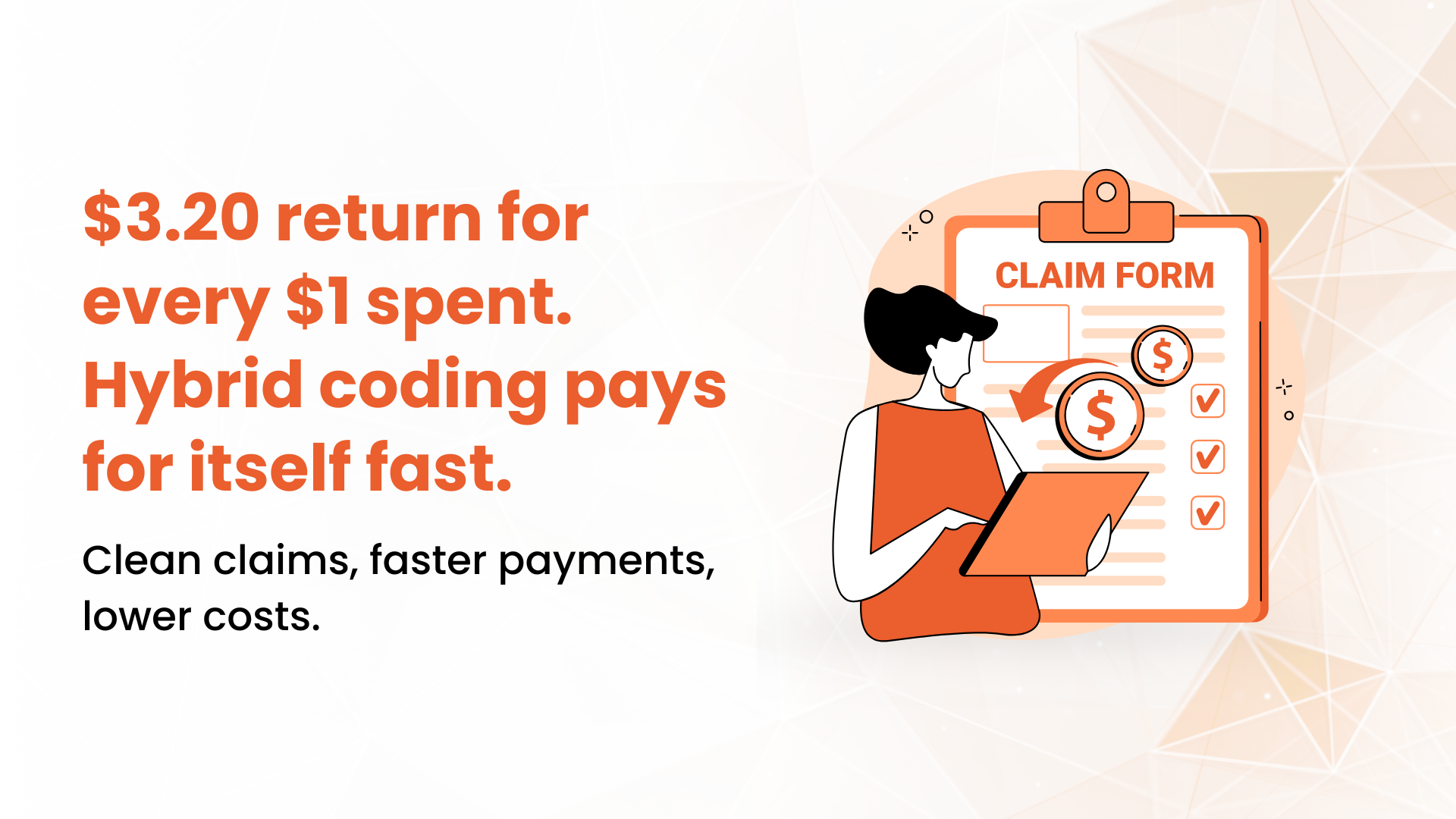
- Industry assessments show an average ROI of $3.20 per $1 invested, realized within 14 months of deployment.
Those returns include reduced cost-per-chart, fewer denials, reclaimed revenue, and improved staff throughput.
Key Metrics Supporting ROI Gains
Here’s what real hybrid implementations deliver:
- Denial rate reduction of 30–50% and sometimes up to 68%, thanks to AI flagging errors early and human review closing gaps.
- Coding error reduction of 50%, faster claims processing, and improved clean-claim rates.
- Staff efficiency rises by 30–65%, as coders shift from routine work to exception management.
- Administrative cost reductions of 35–50% over 12–18 months. A mid-sized hospital posted $2.4 million in savings within this window.
Why These Metrics Matter for You
- Cleaner claims submitted faster streamline revenue flow and reduce days in AR (average receivables), typically by 20–35%.
- Denial management becomes strategic, shifting from reactive appeal to proactive prevention via hybrid workflows.
- Operational strain eases, as coders take on fewer repetitive tasks and more analytical oversight, improving morale and retention.
What Leaders Report
A Modern Healthcare survey showed that 75% of healthcare executives who deployed AI in RCM reported a positive ROI, with 71% reporting increased revenue and over 50% citing fewer human errors.
As Dayne Hoffman from Notable noted: “Forward-thinking health systems are using AI and automation to reduce administrative drag.”
Clients reported 30% ROI, with 15,000 staff hours saved per month and 99.5% documentation accuracy.
How Medical Coding AI+Staff Hybrid Model Enhances Your ROI
Here’s how embedding denial management services and AI tools into your hybrid model amplifies returns:
- Denial Management AI detects high-risk claims before submission, cutting errors early.
- Denial Management Services involve expert human review of flagged items, enabling 50–68% denial reduction and reclaiming revenue from appeals.
- When paired with your Medical AI coding hybrid model, this combination delivers efficiency, accuracy, speed, and financial protection, all aligned with compliance expectations.
Key Technologies Enabling the Hybrid Model
What Technologies Power a Medical AI Coding Hybrid Model?
To build an effective medical AI coding hybrid model, you need robust technologies that support both automation and oversight. These core tech components ensure efficiency, accuracy, compliance, and continuous learning.
Core Technology Pillars
Natural Language Processing (NLP) & Large Language Models (LLMs)
NLP engines and LLMs digest clinical notes, extract structured data, and translate free-text into accurate ICD, CPT, or HCPCS codes. These tools reduce reliance on rules-based systems and improve adaptability, which delivers 99%+ accuracy with minimal human editing.
Confidence Scoring & Explainability
AI assigns a confidence score to each code. If the score is below a threshold, the case is flagged for human review. Advanced systems are used to show a coder the exact phrasing or rationale behind AI decisions, aiding human validation.
Federated Learning & Data Privacy
Federated learning allows AI systems to learn from distributed datasets without centralizing PHI, which strengthens privacy and promotes model quality across multiple facilities. Tools built with immutable audit trails support compliance and training without risking data exposure.
Integrated Audit Dashboards & Anomaly Detection
Hybrid systems include dashboards that help coders and auditors spot outliers, anomalies, and risk patterns automatically. For example, Keragon’s self-audit dashboards launched in May 2025, flagging coding inconsistencies so certified reviewers can intervene.
EHR Integration & RCM Workflow Orchestration
Deep integration with electronic health records (EHRs) ensures real-time code generation. It feeds clinical data directly into AI systems and routes low- and high-confidence charts through the hybrid review process. This increases throughput, accuracy, and system interoperability.
Why These Technologies Matter to You
- Scalability: NLP and AI automate routine charts, freeing staff to focus on exceptions and audits. This drives coder productivity by 30–65% and reduces costs by up to 35%. (See derived stats from earlier sections.)
- Accuracy & Trust: Explainable AI and entity linking give human coders transparency into AI reasoning. That builds confidence and ensures aligned compliance.
- Privacy & Governance: Federated learning with audit trails meets HIPAA and policy requirements. It lets you scale AI safely across locations.
- Real-Time Control: Dashboards and EHR-connected workflows put you in control, letting you audit, monitor, and intervene as needed without missing a beat.
How It Integrates with These Technologies
When you implement denial management AI and services into your hybrid strategy:
- Their systems leverage NLP-driven denial-flagging to identify risky coding patterns before claims are submitted.
- AI confidence scores and explain ability tools highlight which cases should go to human review.
- Their human-led denial management services interface seamlessly with RCM workflows, ensuring oversight, audit logging, and coder validation at each step.
Together, these technologies power your medical AI coding hybrid model, making it efficient, compliant, and driven toward continuous improvement.
How to Implement a Hybrid Model in Q3 2025
How to Launch Your Medical AI Coding Hybrid Model
Here are the steps you take to build a scalable, compliant hybrid coding model by Q3 2025 with a clear implementation roadmap that you can start today.
Step‑by‑Step Rollout Plan
-
Pilot & Baseline Metrics
- Identify a high-volume coding function (e.g., outpatient or risk adjustment charts) to pilot.
- Measure baseline metrics: denial rate, clean‑claim rate, turnaround time, coder hours.
-
Vendor Selection & Tech Integration
- Deploy an AI medical billing tool for Q3 2025 with real-time EHR integration and a confidence‑scoring engine.
- Integrate denial management AI and services into your RCM workflow. Their system connects with PMS/EHR platforms like Epic, Allscripts, and PatientOS to flag, categorize, and route denials automatically.
-
Workflow & Governance Design
- Set confidence thresholds for auto‑posting vs. human review.
- Define escalation rules, audit loops, feedback mechanisms, and attestation steps to comply with CMS RADV and OIG/DOJ expectations.
-
Training & Change Management
- Upskill coders in exception review, audit dashboards, and explainable AI logic.
- Present the leadership change: explain how your medical AI coding hybrid model boosts ROI, accuracy, and revenue protection. Use AHA’s AI action plan framework: people, process, technology.
-
Measure, Optimize, & Expand
- Track pilot performance: denial reduction, cycle‑time improvements, coder productivity.
- Roll out across additional departments once baseline goals (e.g. 50% denial reduction, ≥99% accuracy) are proven.
- Continuously feed human-reviewed corrections back into AI to tighten confidence and reduce manual caseload.
What Roles Do You Need to Involve
- RCM Leader or Director: Oversees pilot execution, parameters, and results.
- Compliance/HIPAA Officer: Ensures audit logs, transparency, and regulatory alignment.
- AI/IT Lead: Handles technical integration, explainability features, and dashboards.
- Human Coding Staff: Transition into dual-review and exception handling roles.
Timeline: First 90 Days (Q3 2025 Ramp-Up)
| Phase | Activities | Expected Outcome |
| Weeks 1–2 | Baseline measurement and scoping | Clear metrics and confidence thresholds |
| Weeks 3–5 | Tech deployment & denial‑flagging onboard | Real-time chart flags, initial integrations |
| Weeks 6–8 | Staff training, audit loop activation | Coders understand hybrid procedures |
| Weeks 9–12 | First pilot evaluation and optimization | 30–50% denial reduction, ≥95% accuracy |
Once you hit target thresholds consistently, you’re ready to scale the hybrid model across coding types and departments.
How Supports Your Deployment
- Their denial workflow tool seamlessly connects with systems like Epic and Patient OS to identify denial types and auto-create work queues for appeals, often resolving denials within 24–48 hours.
- Denial management services help handle appeals, correct root causes, and guide coder training, delivering sustained denial rate reductions of 50–68%.
- This dual approach amplifies your hybrid model’s results, balancing AI’s speed with human oversight to ensure accuracy, compliance, and measurable ROI.
Addressing Common Concerns from Medical Coders
Is My Job at Risk in This Hybrid Model?
The answer is simple: no. A Medical AI coding hybrid model is designed to support, not displace, you. AI handles routine, high-volume tasks, but human coders retain authority over complex cases, coding decisions, and compliance.
Common Concerns and How to Address Them
AI Will Replace Coders
Surveys show that 75% of employees worry AI could make their jobs obsolete 65% fear their roles will be replaced entirely. Yet industry experts confirm that coders bring indispensable judgment, context, and compliance oversight that AI cannot replicate.
Increased Work Stress, Surveillance, or Loss of Autonomy
AI integration can feel intrusive if implemented poorly. But thoughtful hybrid models like yours empower coders through explainable AI, meaningful feedback loops, and shared decision-making.
Keeping Up with New Skills
You’ll need to stay up-to-date on evolving CPT/HCPCS systems, telehealth modifiers, and emerging ICD-11 guidelines. But that’s a reason to lean on the hybrid model not fear it. Upskilling becomes part of your career growth.
Why Coders Thrive in a Hybrid Workflow
- You become quality assurance leaders, not data-entry operators. AI does the routine; you review edge cases, exceptions, and complex charts.
- Your role shifts toward auditing, feedback loops, and governance, increasing your value and control.
- Coders embedded in hybrid teams remain highly employable. Employment growth for medical records specialists is projected at 9% over 2023–2033.
Leadership Voices Reassuring Coders
Stanford Health Care’s billing leadership confirms:
“There’s a human in the middle to reap the real advantages of AI, but it’s not a substitute for human expertise.”
As Bill Richardson noted to RCM leaders in 2025:
“The question now is not if AI will replace coders, but how AI and humans will work together more efficiently.”
How It Supports Your Team, Not Replaces You
When you work with denial management AI and services, coders retain decision-making ownership:
- AI flags high-risk or error-prone charts.
- Expert human coders review those flags, resolve issues, and ensure compliance.
- Coders continually learn from AI feedback, improving accuracy while reducing repetitive coding burdens.
This setup lets you focus on high-value work, driving productivity while preserving your expertise.
The Future of Medical Coding Beyond 2025
What Comes Next for Your Coding Strategy?
Even beyond 2025, this approach will be your best path forward, evolving into more intelligent, decentralized, and human-centered models.
Emerging Trends in Hybrid Medical Coding Solutions
Edge-Based AI Processing
Advances in portable computing and secure, on-device AI will enable coding at the point of care, reducing latency and improving data privacy. Some systems can now preview codes at the clinician’s workstation before even sending charts to RCM queues.
Generative AI for Clinical Documentation
AI that drafts SOAP notes, clinical summaries, and coding rationale will become more accurate, reducing coder effort. These tools speed coding and increase documentation completeness while still depending on human validation before submission.
Federated Model Lifecycles
AI systems will learn collectively across health systems without consolidating PHI, using federated learning to stay current with rare diagnoses and shifting payer policies without compromising privacy or compliance standards.
Explainable & Ethical AI Design
You’ll need models that offer traceability and transparency so every coding decision AI makes is explainable in audits. Expect standards that require fairness, bias mitigation, and human oversight baked in.
The Long-Term Benefits You’ll Experience
- Higher accuracy over time: AI learns from your environment and becomes highly tuned to your workflows, coders’ corrections, and clinical specialties.
- Greater staff engagement: Coders evolve into auditors, educators, and exception handlers, not data entry workers. Job roles become more rewarding and strategic.
- Broader applicability: Hybrid models adapt to coding demands across outpatient, behavioral health, telehealth, and risk adjustment coding programs, enabling scalability and flexibility.
Staying Ahead: How Organizations Prepare Now
- Pilot generative documentation tools and iterate on human review workflows before widespread rollout.
- Test edge-based AI coding at select clinics where privacy is paramount or connectivity is limited.
- Shape governance for explainable AI implement audit dashboards, metadata tracking, and review controls.
- Monitor federated learning pilots and knowledge-sharing systems that improve model accuracy without centralized PHI storage.
These steps position you as a forward-thinking healthcare leader shaping the next era of revenue cycle innovation.
How BillingParadise Positions You for the Future
BillingParadise already builds hybrid solutions with future-forward features:
- Their AI tools flag evolving denial patterns in real time, supported by audit logging and board-ready dashboards.
- Their human denial management services adapt to policy and payer shifts, helping you stay ahead in remote review and payer appeals workflows.
- As generative and explainable AI becomes mainstream, BillingParadise will continue supporting a medical AI coding hybrid model that is compliant, intelligent, and human-centric.
Frequently Asked Questions
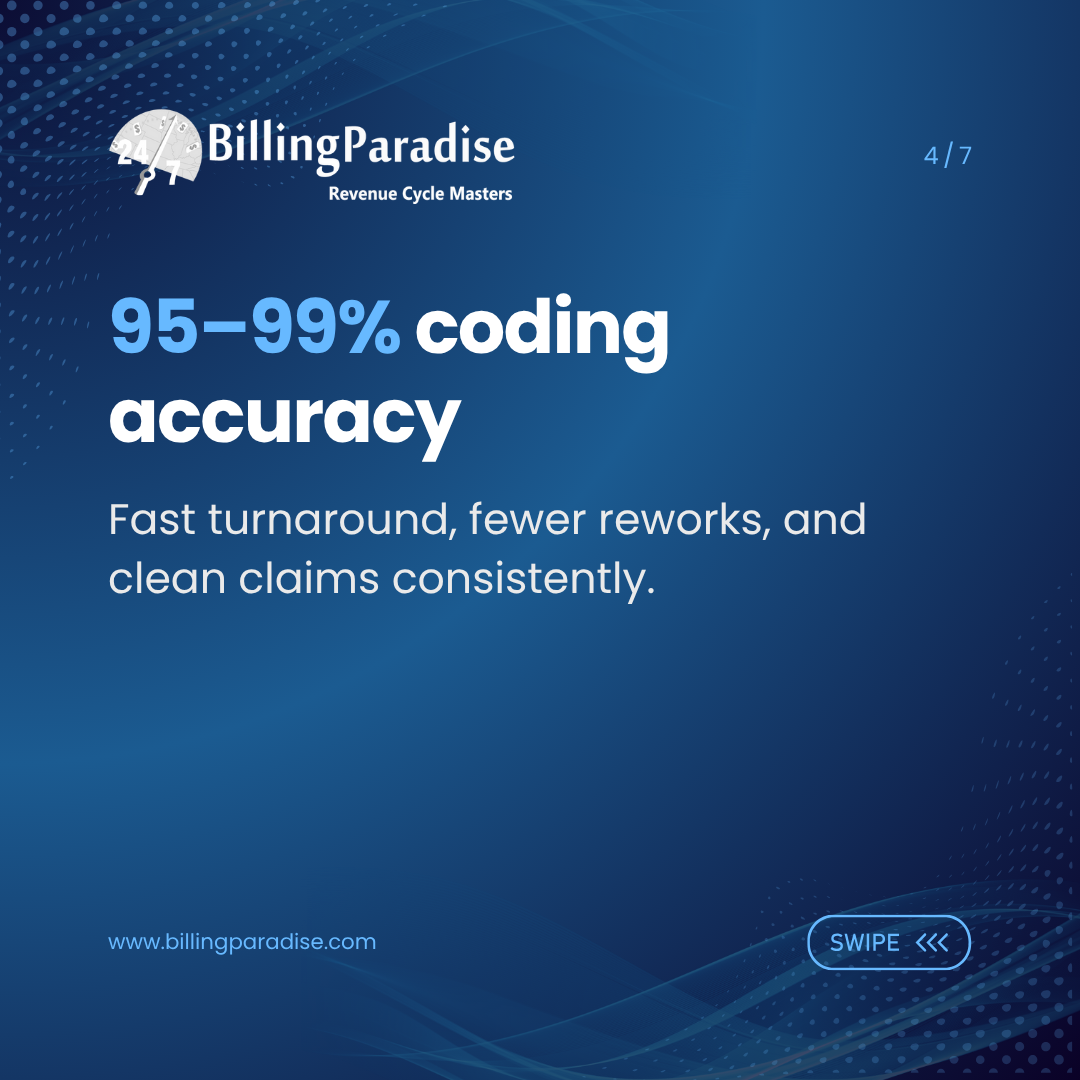
No, it’s not too late. Adoption is well underway, compliance frameworks have matured, and proven blueprints are available. Hospitals that act now can still achieve 95–99% accuracy, 50–68% denial reduction, and 30% + ROI within months.
In a medical AI coding hybrid model, artificial intelligence handles routine, high-confidence coding while human coders review exceptions, handle ambiguity, and ensure compliance. AI-only solutions may process bulk volume quickly, but they still deliver error rates of 12–18% in complex charts, increasing denial risk and revenue loss. The hybrid model balances scale with quality.
No. Surveys show many coders fear job loss, but the reality is the opposite: coders remain essential for handling complex cases, governance, and exception management. In a hybrid model, AI supports coders by automating repetitive tasks while human expertise ensures clean claims.
Conservative estimates show 3× returns on investment, while optimistic cases reach up to 5× ROI within a year. Hybrid systems typically reduce denials by up to 68%, increase productivity by 30–65%, and shrink accounts receivable by 20–35%.
It embeds human review into every AI-generated code, aligning with CMS RADV mandates and payer contract requirements. Traceable audit logs and coder attestation support OIG/DOJ oversight and future regulatory audits.
You can eliminate routine chart backlog, offload coder burnout, reduce denial rework, reclaim lost revenue, and create a scalable RCM workflow all while protecting quality, accuracy, and compliance.
BillingParadise’s denial management AI and services support your hybrid model by proactively flagging high-risk claims, routing exception reviews to certified coders, and resolving denials efficiently. They deliver measurable denial reductions (50–68%), clean-claim increases, coder relief, and alignment with payer and compliance demands.