Healthcare organizations today face increasing financial pressure, and Healthcare Revenue Leakage is one of the biggest threats to their financial stability. Despite efforts to streamline revenue cycle management (RCM), providers are still losing a significant portion of their revenue due to inefficiencies, administrative errors, evolving payer regulations, and emerging cybersecurity threats.
A recent study revealed that U.S. hospitals lose an estimated $12 billion annually due to Healthcare Revenue Leakage, that happens due to various factors, such as poor communication ( University Of Maryland ). This loss is not only detrimental to financial performance but also affects patient care quality, staffing, and long-term operational sustainability.
Understanding why Hospital Revenue Leakage occurs and how to prevent it is essential for healthcare organizations aiming to optimize their revenue cycle by adopting the best revenue cycle management services.
What Causes Healthcare Revenue Leakage?
Hospital Revenue leakage happens at various stages of the revenue cycle, from patient registration to final payment collection. The key contributors include:
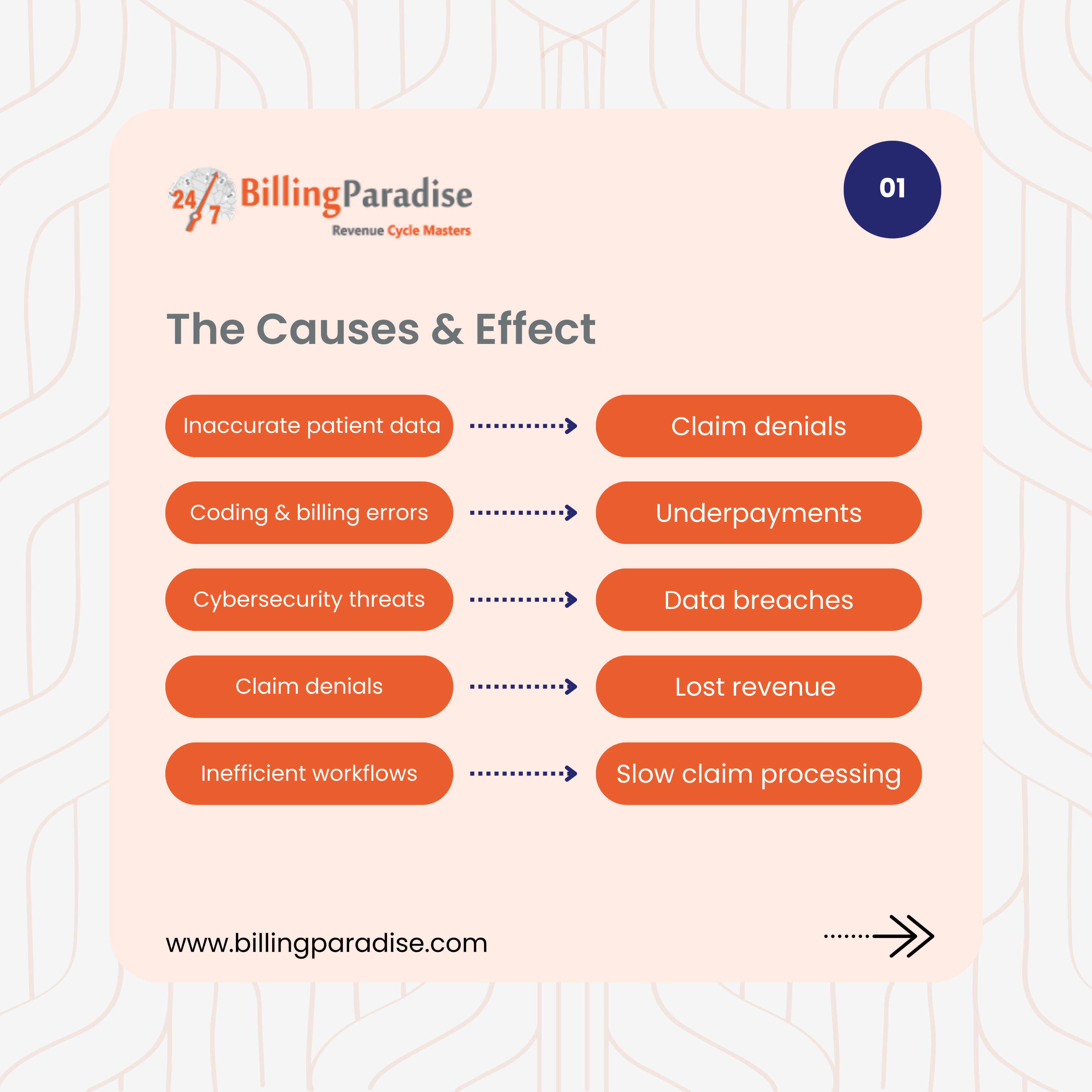
1. Inaccurate Patient Data and Insurance Eligibility Issues
Incorrect or incomplete patient data, such as errors in demographic information or outdated insurance details, can lead to healthcare denials or delays. Many organizations still rely on manual verification processes, increasing the risk of errors. A simple typographical error in a patient’s insurance ID can lead to claim rejections and delays in reimbursement.
2. Coding Errors and Billing Mistakes
Medical coding plays a critical role in reimbursement. If codes are missing, incorrectly assigned, or outdated, claims are often denied or underpaid. Studies indicate that coding errors contribute to nearly 40% of all denied claims. In addition, unbundling of codes, incorrect modifier usage, and lack of medical necessity documentation can create revenue leaks that go unnoticed until audits uncover them.
3. Cybersecurity Threats and Data Breaches
Cyberattacks and data breaches are increasingly affecting healthcare organizations, leading to revenue loss and regulatory penalties. A single ransomware attack can disrupt billing systems, delay claim submissions, and result in HIPAA violations that incur costly fines. Additionally, stolen patient information can lead to fraudulent claims and revenue misallocation, further exacerbating financial losses.
4. Claim Healthcare Denials and Underpayments
Insurance companies frequently deny claims due to documentation issues, lack of prior authorization, or non-compliance with payer policies. Additionally, underpayments occur when reimbursements are lower than the contracted rates. In many cases, hospitals and providers fail to challenge these underpayments, leaving significant amounts of revenue uncollected.
5. Uncollected Patient Payments
With the rise of high-deductible health plans, patients are responsible for a larger portion of their healthcare costs. However, many organizations struggle with collecting payments due to ineffective patient communication, lack of payment plans, or outdated billing processes. Many patients are unaware of their financial obligations, leading to delays in payments and bad debt accumulation.
6. Inefficient Revenue Cycle Workflows
Outdated systems, manual workflows, and lack of automation slow down revenue cycle processes and cause hospital revenue leakage. Without standardized workflows, Healthcare Revenue Leakage becomes inevitable due to inefficiencies and human errors. Healthcare organizations often use multiple systems that do not communicate effectively, causing billing errors and claim submission delays.
7. Lack of Data Visibility and Performance Analytics
Many healthcare organizations lack the necessary analytics to track revenue performance. Without proper insights into healthcare denial rates, claim processing times, and collection trends, identifying and fixing Healthcare Revenue Leakage becomes difficult. Real-time analytics tools can help track claims, monitor payer reimbursements, and flag potential revenue gaps before they impact financial performance.

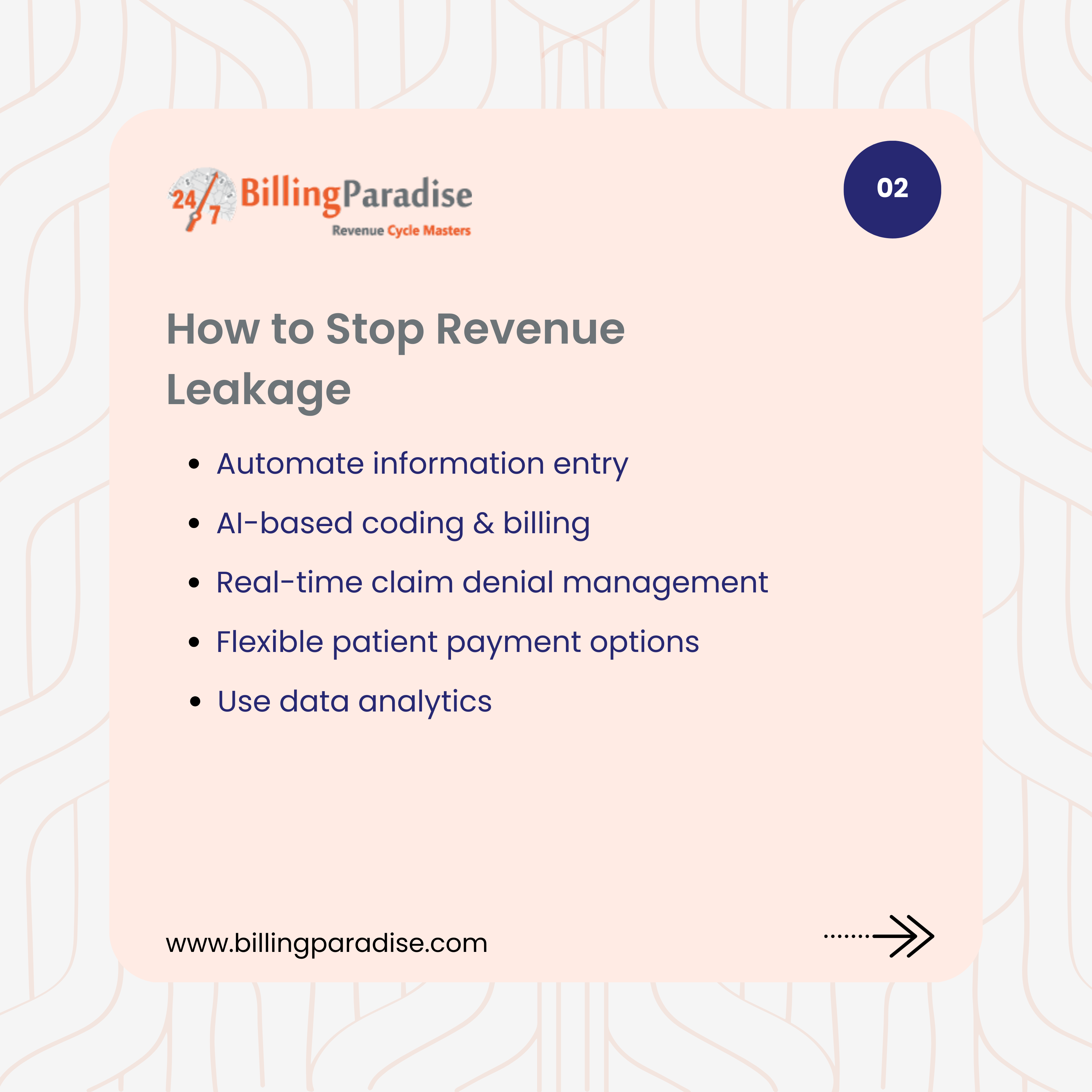
How to Stop Healthcare Revenue Leakage
Preventing Healthcare Revenue Leakage requires a strategic and data-driven approach. Here are key strategies healthcare organizations can implement:
1. Ensure Accurate Patient Registration and Insurance Verification
Automating patient registration and insurance verification can significantly reduce errors. Real-time eligibility checks ensure that insurance details are accurate before services are provided, reducing claim healthcare denials due to eligibility issues. Digital check-in and patient portals can also help patients update their information, minimizing manual entry errors.
2. Enhance Medical Coding Accuracy
Investing in professional coders and AI-driven coding solutions can help minimize coding errors. American Academy of Family Physicians (AAFP) found coding errors can cost a sole practitioner up to $50,000 in lost revenue annually ( MedLearn Publishing ). Regular training, coding audits, and compliance monitoring ensure that documentation is accurate and up to date with payer requirements. Using natural language processing (NLP) and machine learning tools, providers can automate medical coding and ensure precise documentation.
3. Implement a Strong Healthcare Denial Management Strategy
Organizations should analyze claim healthcare denial patterns and address common reasons proactively. Implementing an automated claims tracking system ensures that denied claims are resubmitted quickly, improving revenue recovery. Regular audits and appeals on incorrectly denied claims can significantly improve revenue retention.
4. Optimize Patient Payment Collection
Offering multiple payment options, automated reminders, and transparent billing can improve patient collections. Financial counseling and flexible payment plans also encourage patients to pay their outstanding balances. Providing patients with digital payment solutions and self-service options can improve collections and reduce bad debt.
5. Leverage AI and Automation in Revenue Cycle Management
AI-powered revenue cycle solutions streamline billing, coding, and claims management. Automation reduces human errors, speeds up claim processing, and enhances reimbursement accuracy. AI can also predict potential denials and recommend corrections before claims are submitted, reducing back-and-forth delays.
6. Utilize Data Analytics for Revenue Optimization
Implementing robust revenue cycle analytics helps organizations identify trends, measure key performance indicators, and pinpoint Healthcare Revenue Leakage sources. Data-driven decision-making improves financial performance and operational efficiency. Predictive analytics can provide insights into patient payment behaviors, claim adjudication trends, and reimbursement bottlenecks.
7. Strengthen Cybersecurity Measures
Investing in cybersecurity solutions, such as multi-factor authentication, AI-driven fraud detection, and secure cloud-based RCM platforms, can prevent data breaches and financial fraud. Regular security assessments and staff training also help mitigate risks associated with cyberattacks.
8. Improve Contract Management and Payer Negotiations
Many organizations experience Healthcare Revenue Leakage due to underpayments and contract discrepancies. Regular contract reviews and renegotiations with payers ensure that providers receive accurate reimbursements. A structured contract management system can prevent revenue loss due to outdated payer agreements.
9. Expand Telehealth Revenue Capture
With the rise of telehealth, providers must ensure they are billing correctly for virtual visits. Proper documentation, coding, and compliance with telehealth billing guidelines can help organizations capture full reimbursement for remote care services.
10. Enhance Staff Training and Education
Revenue cycle staff should receive continuous training on coding updates, billing regulations, and payer policies. Well-trained staff can improve claim accuracy and prevent Healthcare Revenue Leakage caused by human errors. In addition, fostering a culture of compliance can reduce financial risks associated with audits and penalties.
How Revenue Cycle Management Consultants Help
Revenue cycle management (RCM) consultants play a crucial role in helping healthcare organizations address Healthcare Revenue Leakage. They provide expert guidance on optimizing revenue cycle processes, implementing best practices, and adopting advanced technologies to enhance financial performance.
Why Choose BillingParadise for Revenue Cycle Management?
BillingParadise is a 20-year-old revenue cycle and healthcare AI and automation company. We provide complete revenue cycle management services, staff support for revenue cycle operations, and RCM AI and automation solutions.
At BillingParadise, we offer evidence-based solutions that empower healthcare leaders to resolve their revenue challenges. Our expertise in AI-driven revenue cycle optimization, claim denial management, and patient payment strategies ensures that healthcare organizations achieve financial stability and operational efficiency.
If your organization is struggling with Healthcare Revenue Leakage, BillingParadise can help you implement tailored solutions that improve collections, streamline processes, and maximize revenue.
Take control of your revenue cycle today and prevent Healthcare Revenue Leakage with the right strategies and expert support.