The healthcare industry has witnessed a digital transformation in recent years, with the adoption of Electronic Medical Records (EMRs) leading the way. The findings of this study revealed that approximately half (56.5%) of health managers were current users of the EMR system, of whom 73.6% used the system on a daily basis. Among them, approximately 125 (40.6%) used EMR data in decision-making ( Frontiers ). One of the key features integrated into modern EMRs is the charge capture tool. These tools, designed to simplify the billing process, aim to help physicians accurately document and charge for their services. However, these EMR-embedded charge capture tools have introduced a new challenge—revenue drift—leaving physician practices grappling with hidden revenue losses.
This blog explores the pitfalls of relying solely on EMR-embedded charge capture tools, how this leads to revenue drift, and how Revenue Management Consultants (RMCs) with RCM Automation are stepping in to bridge the gap. It also discusses ways practices can leverage these tools effectively to optimize their revenue.
The Charge Capture Conundrum: Understanding Revenue Drift
What Is Revenue Drift?
Every week, the charge capture system was reporting upwards of 1,200 missing-charge errors, each of which required members of the revenue and clinical teams to parse through the data manually. ( HFMA ). Revenue drift occurs when there is a gradual, unnoticed decline in a healthcare financial management. This is not caused by a single catastrophic event but by inefficiencies and errors that accumulate over time. For physician practices, charge capture errors are a leading contributor to this phenomenon.
Why Are EMR-Embedded Tools Falling Short?
While EMR-embedded charge capture tools are convenient, their design often prioritizes documentation over revenue optimization. Here’s how they contribute to revenue drift:
1-Limited Customization
Many EMR tools lack the flexibility to accommodate the unique workflows of different specialties. As a result, physicians may overlook charges or fail to document services that do not fit neatly into the EMR’s templates.
2-Inadequate Training and Usability
Healthcare providers are not always trained extensively on the nuances of the charge capture functionality within their EMRs. This leads to underutilization or errors during documentation.
3-Manual Entry Errors
Physicians often juggle patient care and administrative tasks, leading to rushed or incomplete charge entry. The manual nature of some processes within EMR-embedded tools increases the likelihood of mistakes.
4-Missed Revenue Opportunities
Certain EMR systems fail to flag undercoded services or missed billing opportunities. These gaps are particularly detrimental to practices in specialties like surgery or cardiology, where complex procedures are involved.
5-Lack of Real-Time Insights
EMR-embedded tools often lack robust analytics to provide real-time feedback on charge capture performance. Without visibility into revenue patterns, practices are unable to proactively address revenue leaks.
Strategies for Leveraging EMR-Embedded Charge Capture Tools Effectively
While the limitations of EMR-embedded tools cannot be ignored, practices can implement strategies to maximize their utility. Here’s how the healthcare financial management process can make the most of these tools:
Custom Configuration of EMR Systems
Work with EMR vendors or consultants to customize templates and workflows to match your practice’s needs. Tailored configurations reduce the likelihood of missed charges.
Adopt Proactive Training Approaches
Continuous education is key. Regularly update staff on coding changes, documentation best practices, and the features of your EMR charge capture tool.
Integrate with External Solutions
Pair EMR-embedded tools with third-party solutions designed to complement charge capture processes. Advanced tools can provide coding suggestions, flag discrepancies, and integrate seamlessly with EMRs.
Monitor Metrics Regularly
Establish key performance indicators (KPIs) to measure the effectiveness of your charge capture process. Metrics like charge lag time, denial rates, and revenue variance can provide valuable insights.
Collaborate with Revenue Cycle Experts
Engage external experts to audit your processes, provide real-time feedback, and recommend actionable improvements. Their objective perspective can help you uncover issues that internal teams might overlook.
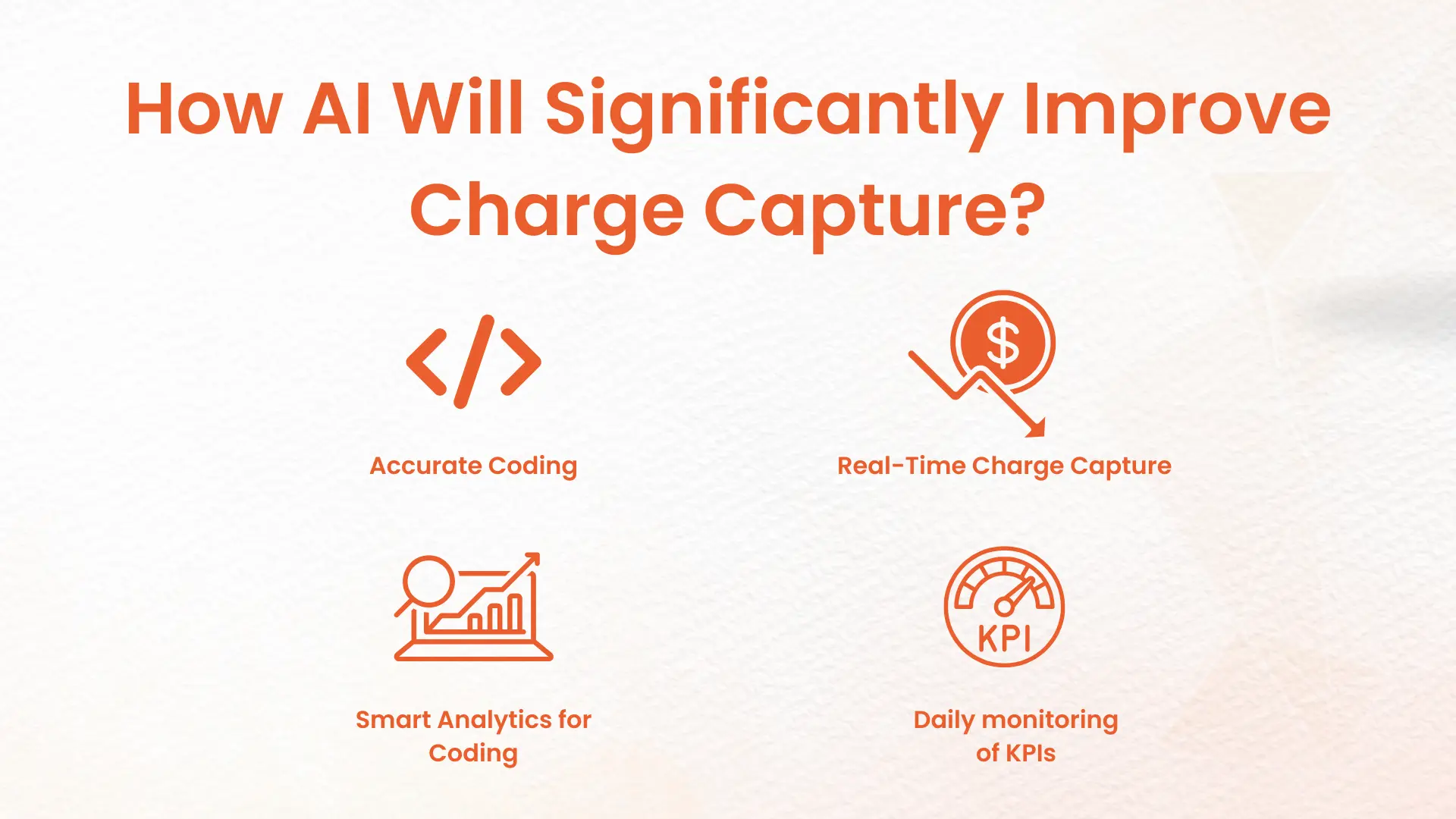
How AI Will Significantly Improve Coding and Charge Capture
Enhanced Accuracy in Coding
AI technologies utilize natural language processing (NLP) to analyze clinical documentation and automatically assign accurate codes. By understanding the context and intent behind physician notes, AI minimizes common errors like undercoding, which leads to missed revenue, and overcoding, which risks compliance issues and audits. This not only streamlines the coding process but also ensures alignment with evolving industry standards, safeguarding against denials and financial losses.
Real-Time Charge Capture
AI-powered tools seamlessly integrate with EMR systems to flag missed charges in real time. By cross-referencing clinical notes and procedures with billed services, AI identifies gaps and alerts staff before claims are submitted. This proactive approach prevents revenue loss by ensuring every service provided is captured accurately, eliminating the guesswork and inefficiencies associated with manual processes.
Smart Analytics for Under- and Over-Coding
Medical coding Automation offers robust analytics to uncover coding patterns and trends, helping organizations identify both under- and over-coding instances. These insights enable practice leaders to pinpoint inefficiencies, correct errors promptly, and enhance overall coding effectiveness, contributing to healthier revenue cycles.
Daily Monitoring and Real-Time Dashboards
With AI-driven dashboards, the healthcare financial management sector gain immediate visibility into coding and charge capture software performance. These dashboards highlight issues such as missing charges or revenue dips, empowering practices to address problems swiftly and maintain optimal financial health.
AI’s ability to streamline coding and charge capture software ensures accurate, compliant, and efficient revenue cycle management.
The Role of Revenue Management Consultants in Bridging the Gap
Revenue Management Consultants play a crucial role in helping healthcare financial management identify and resolve issues contributing to revenue drift. Their expertise in charge capture software and operational workflow design can make a significant difference in minimizing revenue loss.
Comprehensive Revenue Audits
RMCs conduct thorough audits to identify patterns of missed charges, undercoding, and revenue leakage. These audits focus on high-risk areas like surgical procedures, diagnostics, and ancillary services.
Workflow Optimization
By studying the existing workflows in a practice, RMCs help redesign processes to ensure charge capture software becomes an integral part of clinical documentation. This reduces the chances of omissions and manual errors.
Enhanced Training Programs
Revenue consultants offer targeted training for physicians and staff to improve their understanding of EMR-embedded tools. Customized training ensures that the team maximizes the potential of the tools without compromising clinical efficiency.
Integration of Analytics and Reporting
RMCs bring advanced analytics capabilities to practices, enabling them to track revenue trends, identify bottlenecks, and flag missed billing opportunities. These insights empower practices to take corrective action in real-time.
Specialty-Specific Solutions
Understanding the unique requirements of various specialties, RMCs tailor charge capture software to align with specialty-specific medical billing and coding norms.




View the detailed post on LinkedIn
Conclusion:
As practices navigate the challenges posed by EMR-embedded charge capture tools, partnering with the right experts can make all the difference. BillingParadise, a 20-year-old revenue cycle and healthcare AI and automation company, offers evidence-based solutions to resolve these challenges. We provide comprehensive revenue cycle management services, charge capture automation, staff support for revenue cycle operations, and innovative RCM AI and automation solutions.
With BillingParadise, healthcare leaders can achieve sustainable revenue growth while leveraging the full potential of their EMR systems. Our tailored approach ensures that your practice thrives in an increasingly complex healthcare environment.
Take charge of your revenue today with BillingParadise. Let’s put an end to revenue drift, together.