Revenue cycle management (RCM) plays a critical role in maintaining financial stability. Traditionally, RCM has been a manual process, requiring human intervention at every step. A 2024 survey by Inovalon found that 84% of revenue cycle executives are optimistic about AI-enabled RCM, underscoring the growing confidence in AI’s ability to enhance healthcare financial operations (Healthcare IT News). However, with the advent of artificial intelligence (AI), healthcare organizations now have a powerful tool to optimize and streamline revenue operations. This article explores the differences between AI-driven RCM and manual processes, highlighting the cost-effectiveness of AI in RCM and how revenue cycle management consultants implement it to improve efficiency.
Understanding the Manual RCM Process
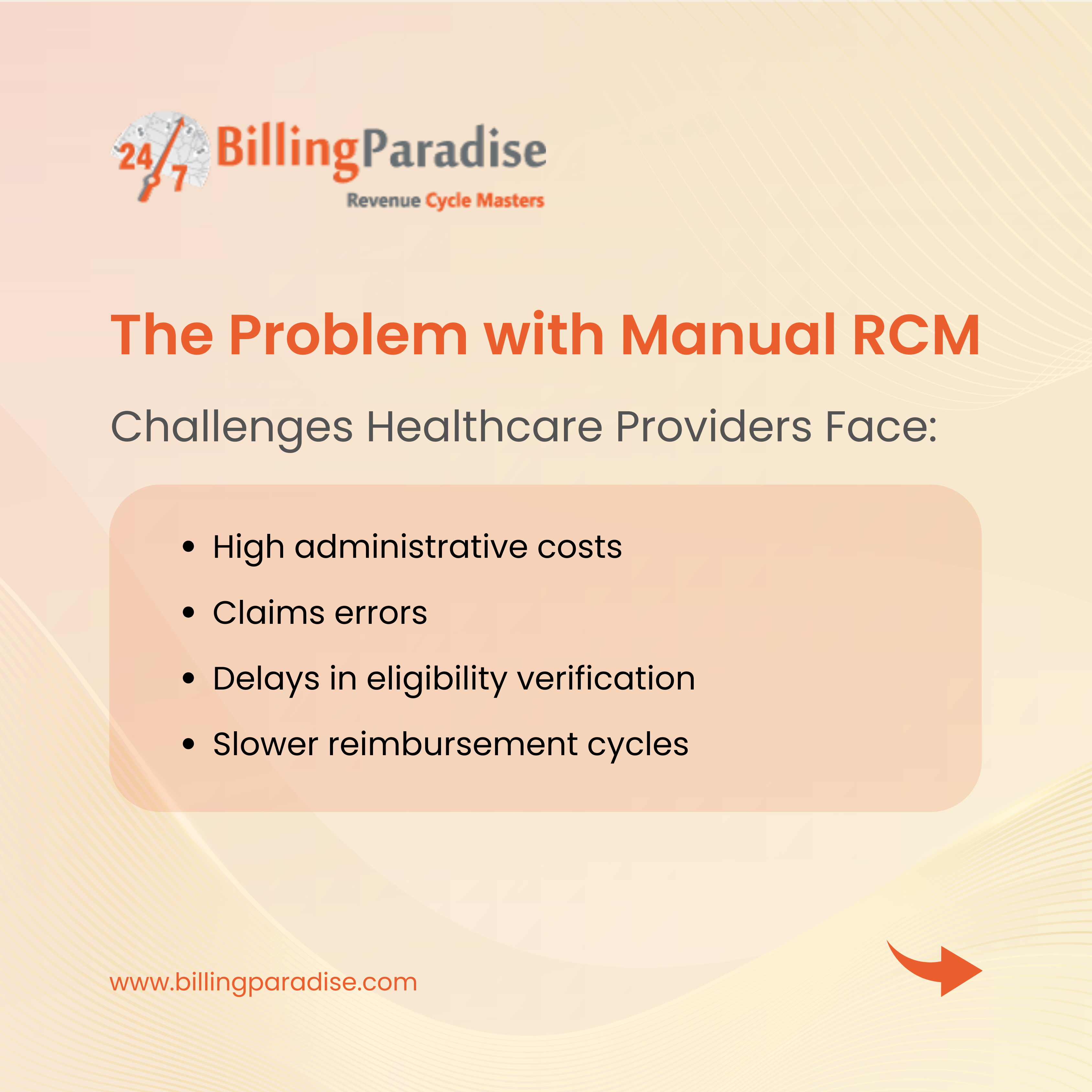
Manual RCM involves a series of time-consuming and labor-intensive tasks, including patient registration, claims submission, payment posting, and denial management. Staff members are responsible for verifying insurance, processing claims, following up on denials, and ensuring payments are received on time. While this approach has been in place for decades, it presents several challenges:
- High Labor Costs – Manual processing requires a large workforce, leading to increased operational expenses.
- Time-Consuming Tasks – Staff must handle repetitive tasks such as data entry, claims follow-ups, and reconciliation, which slow down the revenue cycle.
- Higher Error Rates – Human errors in coding, billing, and insurance verification lead to claim denials and revenue loss.
- Delayed Payments – Inefficiencies in manual processes cause delays in reimbursements, impacting cash flow.
- Compliance Risks – Manual processes increase the risk of non-compliance with constantly evolving healthcare regulations.
- Limited Scalability – Healthcare providers looking to expand often struggle with the constraints of manual RCM.
- Inefficient Denial Management – Without AI in RCM, denial management becomes a reactive process, leading to revenue leakage.
While experienced professionals can manage these tasks effectively, manual RCM remains resource-intensive and prone to inefficiencies.

The Power of AI in RCM
AI in RCM solutions automates key processes, reducing costs and improving efficiency. AI enhances revenue operations in the following ways:
1. Automated Claims Processing
AI in RCM tools automatically generates, reviews, and submits claims with high accuracy. By reducing human intervention, AI minimizes errors and increases first-pass claim approval rates.
2. Intelligent Eligibility Verification
A study examining 4,070 children under five found that delays of more than two days between symptom onset and hospital admission were associated with worse health outcomes, including increased rates of wasting and elevated C-Reactive Protein levels upon discharge ( National Library Of Medicine ). AI-powered eligibility verification tools instantly confirm insurance coverage, reducing claim denials caused by incorrect or missing patient information. This is particularly useful for patient scheduling AI, ensuring that patients have verified coverage before services are scheduled.
3. Predictive Denial Management AI
AI in RCM analyzes historical denial patterns to predict potential claim denials before submission. This proactive approach allows healthcare providers to correct errors in advance, reducing rework and revenue leakage. Denial management AI also helps prioritize claims that need urgent attention, optimizing staff efficiency.
4. Faster Payment Posting
AI in RCM automates payment posting by extracting and matching remittance advice from payers, eliminating the need for manual data entry and accelerating the reconciliation process. This not only improves efficiency but also ensures that revenue cycle teams can focus on more complex tasks.
5. Enhanced Compliance and Auditing
AI in healthcare ensures compliance with changing regulations by automatically updating billing rules and flagging potential compliance risks. AI-driven tools analyze vast amounts of data in real time, reducing the likelihood of audits and penalties.
6. Cost Reduction and Scalability
By reducing the need for extensive human labor, AI in RCM significantly cuts operational costs. Additionally, AI solutions scale easily to meet the demands of growing healthcare organizations without requiring additional resources.
7. Patient Scheduling AI for Operational Efficiency
AI in healthcare also enhances patient appointment scheduling automation management, reducing no-shows and optimizing provider schedules. With AI-driven scheduling, healthcare organizations can ensure better resource utilization and improved patient experiences.
8. Real-Time Revenue Cycle Insights
AI in RCM provides real-time analytics and dashboards that offer insights into key revenue cycle metrics. Healthcare leaders can make data-driven decisions, optimize workflows, and address bottlenecks before they impact cash flow.
9. Improved Patient Experience
With AI-driven self-service portals, patients can check their insurance eligibility, track claim statuses, and make payments effortlessly, enhancing transparency and satisfaction. AI in healthcare significantly improves patient interactions, reducing administrative burdens on staff.
10. Advanced Fraud Detection
AI in healthcare detects fraudulent billing activities by analyzing billing patterns and flagging anomalies. This reduces financial risks and ensures compliance with payer regulations.
Why AI in RCM Is More Cost-Effective Than Manual Processes
The financial benefits of AI in RCM go beyond just automation. Implementing AI in RCM drastically reduces the costs associated with claim denials, administrative overhead, and payment delays.
- Lower Labor Costs – AI reduces dependency on large administrative teams, allowing organizations to allocate resources more efficiently.
- Faster Cash Flow – AI accelerates claims processing and reimbursement cycles, improving revenue stability.
- Reduced Claim Denials – AI-driven denial management AI proactively addresses issues before claims are submitted, reducing the number of denied claims.
- Optimized Resource Utilization – AI in healthcare enhances scheduling, staffing, and operational efficiency, reducing unnecessary expenditures.
- Fewer Compliance Issues – Automated compliance tracking minimizes costly penalties and audits.
With AI in RCM, healthcare providers not only achieve cost savings but also improve financial predictability, ensuring long-term sustainability.
How Revenue Cycle Management Consultants Implement AI in RCM
RCM consultants play a crucial role in helping healthcare organizations transition from manual to AI-driven RCM. Here’s how they implement AI in RCM solutions effectively:
1. Assessing Current RCM Processes
Consultants analyze existing revenue cycle workflows to identify inefficiencies and areas where AI in RCM can have the most impact.
2. Implementing AI-Powered Tools
Consultants introduce AI in RCM-driven solutions such as automated claims processing, predictive denial management AI, and intelligent eligibility verification.
3. Training and Integration
While AI in healthcare automates many tasks, human oversight remains essential. Consultants train staff on AI functionalities and ensure seamless integration with existing systems.
4. Continuous Optimization
AI-driven RCM is not a one-time implementation. Consultants continuously monitor AI performance, adjust algorithms, and refine processes to maximize efficiency.
5. Ensuring Compliance and Security
RCM consultants ensure that AI in RCM solutions comply with HIPAA and other regulatory requirements, safeguarding patient data and financial transactions.
BillingParadise: Your AI-Powered RCM Partner
BillingParadise is a 20-year-old revenue cycle and healthcare AI and automation company. We provide complete revenue cycle management services, staff support for revenue cycle operations, and RCM AI and automation solutions. BillingParadise provides evidence-based solutions for healthcare leaders to resolve their challenges.
By leveraging AI in RCM, we help healthcare organizations reduce costs, improve efficiency, and enhance revenue integrity. If you’re looking to transition from manual RCM to an AI-driven approach, our team is ready to assist.
The shift from manual RCM to AI in RCM solutions is not just a technological advancement—it’s a necessity for healthcare organizations striving for financial stability. AI in healthcare enhances efficiency, reduces costs, minimizes errors, and accelerates payments, making it the preferred choice over traditional manual processes. Partnering with an experienced revenue cycle management consultant ensures a smooth transition, allowing healthcare providers to focus on delivering quality patient care while optimizing their financial performance.