
See Whether Your Transition Is Actually Ready, Not Just Scheduled
A vendor transition inside eClinicalWorks touches claim edit rules, ERA enrollment, role-based access, and AR ownership all at once, and none of it shows up on a single dashboard. Most practices find out something was missed when a payment stops arriving, not before.
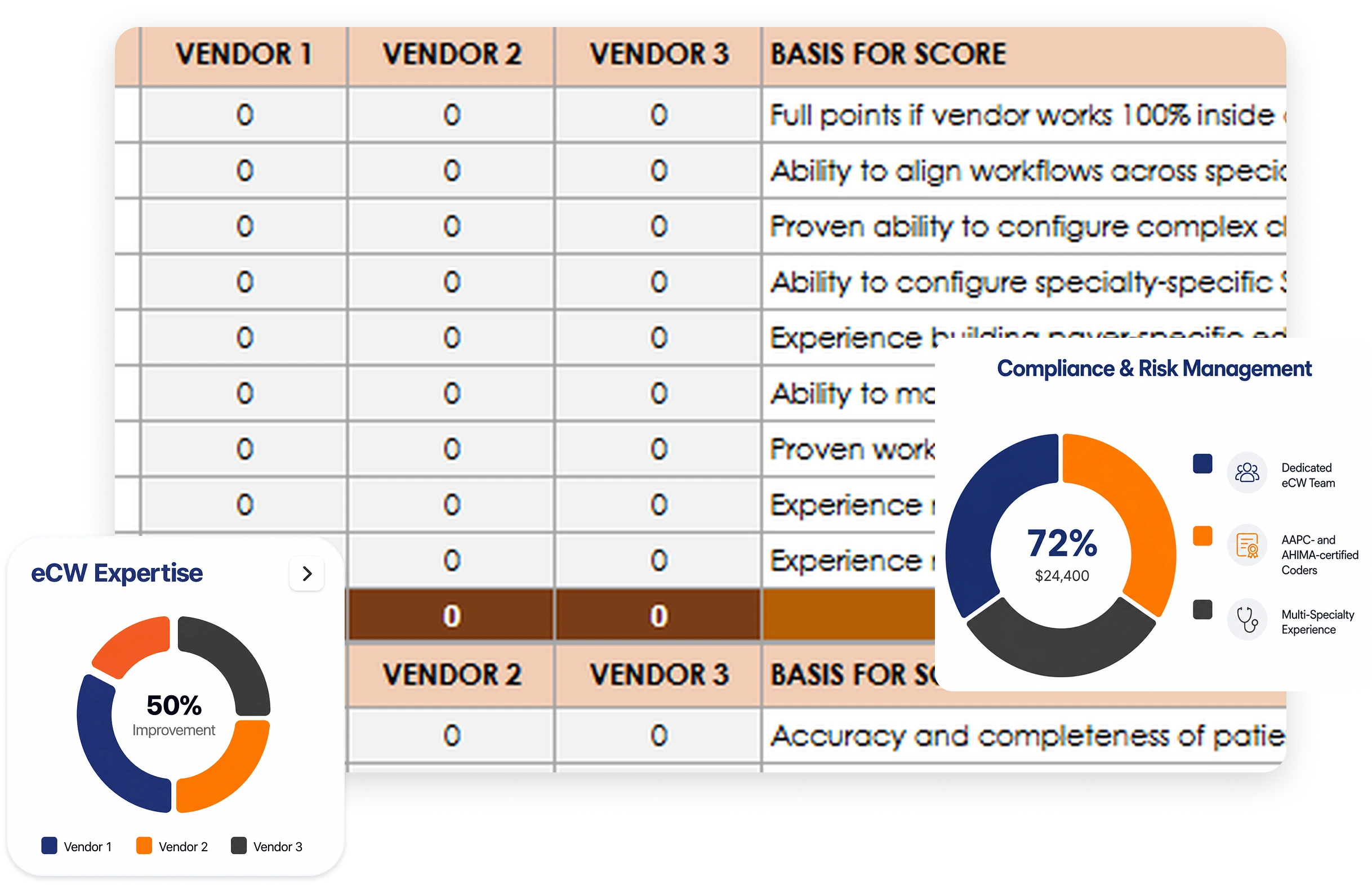
This checklist scores 11 transition areas, from pre-transition alignment through executive sign-off, using a straightforward Yes, No, or Partially scale that rolls up into one compliance percentage. A score under 100 percent isn't a failing grade. It's a list of exactly what still needs an owner before go-live.
What's Inside This Checklist?
One workbook, two tabs: the scored checklist itself, and an overview built for whoever needs the executive summary.
1. Pre-Transition & Discovery
- Confirms leadership is aligned on why you're transitioning and what a successful 90 days actually looks like
- Financial improvement targets get documented up front: AR days, net revenue rate, denial reduction
- A formal billing discovery call and workflow review happen before go-live, not during it
- Clearinghouse access and ERA enrollment get confirmed for every major payer ahead of time
2. System & Clearinghouse Readiness
- AR gets segmented into 0-30, 31-60, 61-90, and 90+ day buckets before the transition starts, with 120+ day AR assigned an owner
- Role-based permissions, separate vendor user IDs, and audit logging get checked inside your live eCW instance
- Claim edit rules and payer-specific edits get reviewed instead of left on default settings
- Payer IDs, ERA activation, and EFT enrollment get validated payer by payer
3. KPI Baseline & Governance
- Clean claim rate, AR days, and net collection rate get documented as a baseline before anything changes
- A 90-day financial projection and weekly post-go-live revenue variance check are both built in
- Weekly meetings, an escalation matrix, and 30/60/90-day reviews get scheduled, not left to happen informally
- Structured monthly scorecards keep governance from fading out after week one
4. Risk Mitigation & Go-Live Sign-Off
- Contingency plans cover delayed claim submission and payment posting continuity
- Underpayment detection and revenue variance tracking run through the transition, not just after it
- Executive sign-off requires technical access, KPI baseline, and AR ownership all confirmed, not assumed
- One compliance percentage shows exactly how ready go-live actually is
Built for Healthcare Leaders Responsible for a Safe RCM Transition
Built for the people who have to answer for a revenue dip that started the same month a new vendor did.


